





The impact of IR cut off filters on image quality and their selection
Mar. 13, 2026
What is an IR-cut filter?
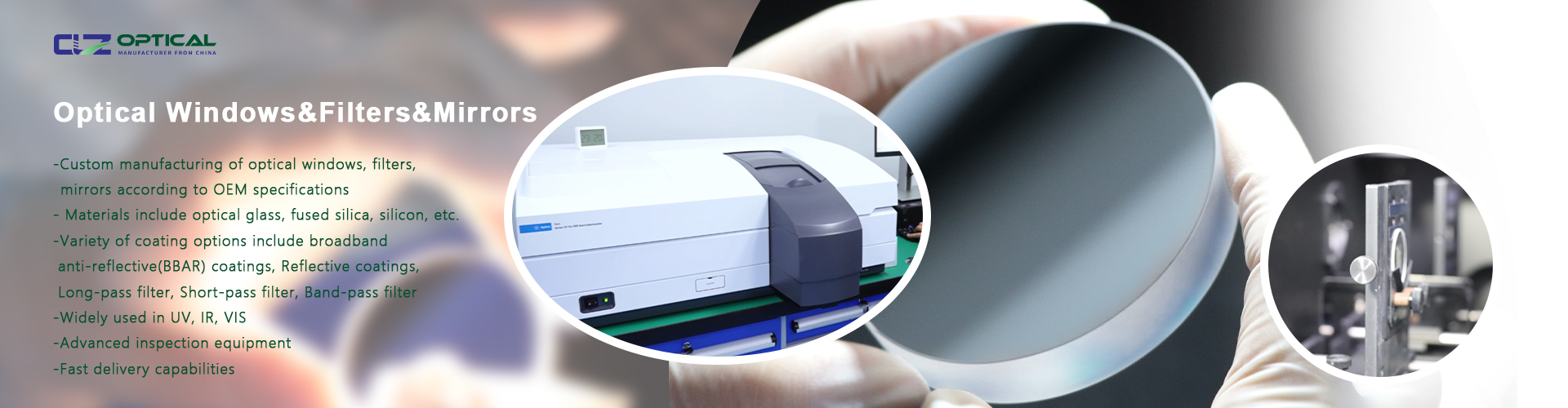
An infrared cut-off filter, also known as an infrared filter or heat-absorbing filter (IR-CUT FILTER, or IRCF for short), is a type of filter used to filter infrared wavelengths. IR-cut filters utilize precision optical coating technology to alternately deposit optical films of high and low refractive indices onto optical substrates such as white glass, blue glass, or resin sheets. Infrared cut-off filters effectively block infrared light that interferes with image quality while maintaining high visible light transmittance, resulting in an image that better matches the optimal perception of the human eye.
IR-cut filters are divided into two types: reflective and absorptive.
Reflective: Ordinary IR cut filters have high transmittance in the visible light region but low reflectance, while the opposite is true in the infrared region, with high reflectance.
Absorption: Blue glass. Blue glass is an absorptive glass; the copper ions in the glass have the function of absorbing infrared radiation, thus absorbing infrared light.
What impact do IR-cut filters have on image quality?
One of the core challenges of imaging systems stems from the difference in spectral response between the human eye and digital sensors. The human eye is only sensitive to the visible light spectrum (400-700nm), while image sensors can perceive a wider range of wavelengths, from ultraviolet to near-infrared (approximately 400-1100nm). Unfiltered infrared light can cause color distortion, reduced contrast, and impaired sharpness in sensor imaging. Infrared cut-off filters, as a crucial component of cameras, are responsible for precisely controlling the spectral band of incoming light, ensuring that the output image meets the visual expectations of the human eye or the specific needs of machine vision. This solves the color deviation problem caused by infrared light participating in imaging, improving image color reproduction, resolution, and sharpness.
How do you select IR-cut filters?
Choosing the right IR-cut filter is crucial for meeting diverse application needs. The selection strategy must comprehensively consider factors such as daytime color accuracy and nighttime sensitivity.
I. Applications Requiring Human Eye Observation
In scenarios where human eye observation is involved, such as video conferencing and mobile devices, the primary requirement is to output high-quality color images that conform to human visual perception. Blue glass filters are ideal for such applications, as they help to reproduce natural colors.
II. All-Weather Security Applications
All-weather security applications require a balance between daytime color imaging and nighttime infrared sensing. The primary choices are an IR-CUT blue glass switching structure or a fixed dual-pass filter. During the day, the system achieves top-quality image quality; at night, it maximizes infrared sensitivity.
III. Machine Vision Applications
Narrow-pass filter technology can accurately extract specific spectral features and effectively eliminate interference from ambient light. Taking face liveness detection as an example, narrow-pass filters can strictly block visible light interference, significantly improving the system's anti-interference capability and detection accuracy.
IV.Selection Considerations for High-End, High-Pixel Cameras
In high-end applications, the selection of cameras requires a comprehensive consideration of technology and system performance to obtain the best image results.
Ultimately, for different application scenarios, we need to find the most suitable technical solutions, and modern filter technology is constantly challenging the physical limits, deeply integrating with optical design, mechanical structure and image algorithms to provide increasingly precise spectral control for various imaging applications.