


High Index Ball Lenses: Precision Optical Components for Compact and High-Performance Systems
Mar. 03, 2026
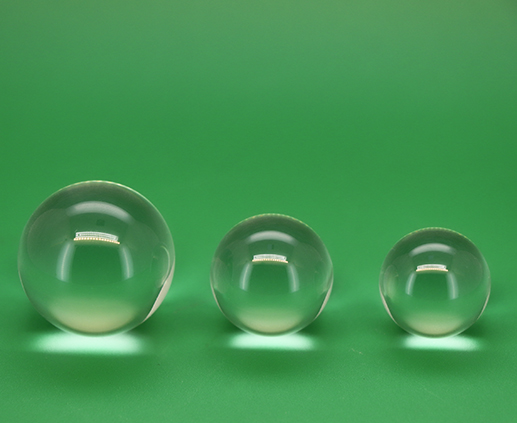
High index ball lenses are spherical optical elements manufactured from materials with a high refractive index, designed to efficiently focus, collimate, and couple light in compact optical systems. Due to their strong light-bending capability and small form factor, these lenses are widely used in fiber optics, laser systems, infrared applications, medical devices, and terahertz technologies.
Compared to standard glass ball lenses, high refractive index ball lenses provide shorter focal lengths, higher numerical apertures, and improved light coupling efficiency—making them ideal for high-precision optical integration.
What Is a High Index Ball Lens?
A high index ball lens is a fully spherical lens made from materials such as:
High-index optical glass
Sapphire
Silicon
Germanium
Zirconia
Cubic zirconia
These materials typically have a refractive index greater than 1.8, and in some cases above 3.0 (such as silicon in IR and THz ranges). The higher the refractive index, the stronger the light focusing capability within a smaller geometry.
Why High Refractive Index Matters
Shorter Focal Length
High index materials bend light more strongly, which reduces the effective focal length. This allows for ultra-compact optical assemblies in space-constrained applications.
Higher Numerical Aperture (NA)
A higher refractive index increases the lens’ ability to collect and focus light, improving signal strength in fiber coupling and detection systems.
Improved Fiber Coupling Efficiency
In optical communication systems, high index ball lenses significantly enhance coupling between laser diodes and single-mode or multimode fibers.
Better Beam Collimation
These lenses efficiently convert divergent beams into collimated outputs, improving optical alignment performance.
Key Optical Properties
When selecting high index ball lenses, the following parameters are critical:
Refractive index (n value)
Diameter tolerance
Surface quality (scratch-dig specification)
Surface roughness
Transmission wavelength range
Roundness precision
Material absorption characteristics
Because reflection increases with refractive index, anti-reflection (AR) coatings are often applied to minimize Fresnel losses and maximize transmission efficiency.
Common Materials Used in High Index Ball Lenses
Optical Glass (n ≈ 1.8–2.1)
Cost-effective for visible and near-infrared applications.
Sapphire (n ≈ 1.76)
Excellent mechanical durability and high-temperature resistance.
Silicon (n ≈ 3.4 in IR/THz)
Ideal for infrared imaging and terahertz systems.
Germanium (n ≈ 4.0 in IR)
Widely used in thermal imaging and long-wave infrared optics.
Zirconia and Cubic Zirconia
Extremely high index and high hardness, commonly used in precision laser systems and medical applications.
Applications of High Index Ball Lenses
Fiber Optic Communication
High index ball lenses are frequently used for:
Fiber-to-fiber coupling
Laser diode to fiber alignment
Optical transceivers
Collimation in photonic modules
Their compact size makes them ideal for dense optical packaging.
Laser Systems
Used in beam shaping, focusing, and alignment in industrial and medical laser devices.
Infrared and Thermal Imaging
Silicon and germanium ball lenses support mid-IR and long-wave IR applications such as thermal cameras and sensing systems.
Medical Devices
Applied in endoscopy, minimally invasive surgical tools, and optical sensors due to their small size and high precision.
Terahertz Systems
High index silicon ball lenses improve coupling efficiency and beam control in THz spectroscopy and imaging systems.
Advantages Over Conventional Lenses
Compared to plano-convex or aspheric lenses, high index ball lenses offer:
Compact spherical geometry
Easier alignment in fiber systems
Lower manufacturing complexity
Uniform focusing characteristics
Cost-effective scalability for volume production
However, because spherical geometry introduces some spherical aberration, system designers must optimize placement and distance to achieve the desired optical performance.
Design Considerations
Reflection Loss
High refractive index materials create higher surface reflections. Applying AR coatings or index-matching techniques significantly improves efficiency.
Mounting and Alignment
Precision mounting is critical to ensure optimal beam coupling, especially in single-mode fiber systems.
Thermal Expansion
Material selection should match system temperature requirements to avoid misalignment in high-temperature environments.
Customization Options
Manufacturers often provide:
Custom diameters (from sub-millimeter to several millimeters)
Tight diameter tolerances
Broadband or wavelength-specific AR coatings
IR or THz optimized materials
High precision surface polishing
Customized ball lenses ensure compatibility with specialized optical assemblies.
Market Trends and Industry Demand
With the rapid growth of:
5G and next-generation optical communication
Industrial laser processing
Infrared sensing and thermal imaging
Biomedical optical instrumentation
Terahertz detection and communication
The demand for compact, high-performance optical components continues to expand. High index ball lenses are becoming increasingly important in miniaturized and high-density photonic systems.
Conclusion
High index ball lenses are compact, high-efficiency optical components designed for advanced focusing, collimation, and fiber coupling applications. Their strong light-bending capability, high numerical aperture, and compatibility with infrared and terahertz wavelengths make them essential in modern optical engineering.
For system designers seeking precision, miniaturization, and enhanced optical performance, high refractive index ball lenses offer a reliable and scalable solution across communication, imaging, laser, and sensing technologies.