


H-K9L Ball Lenses: Properties, Applications, and Optical Performance Guide
May. 22, 2026
H-K9L ball lenses are precision optical components widely used in fiber optics, laser collimation, imaging systems, and sensing devices. Known for their excellent transmission in the visible spectrum and stable physical properties, H-K9L glass ball lenses are a cost-effective and high-performance solution for many optical coupling applications.
What Is an H-K9L Ball Lens?
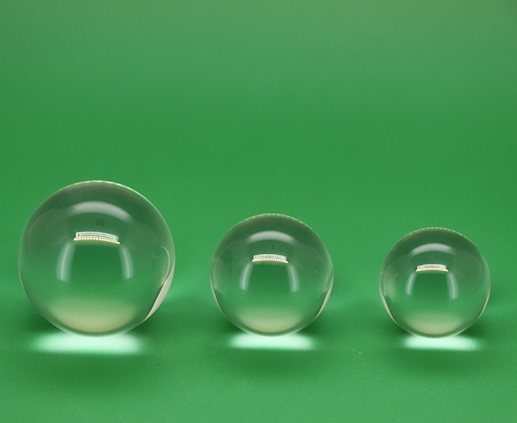
An H-K9L ball lens is a perfectly spherical optical lens made from H-K9L glass, a type of borosilicate crown glass commonly used in precision optics.
Its spherical geometry allows it to focus or collimate light in all directions, depending on how it is used in an optical system. Compared to traditional lenses, ball lenses offer simpler alignment, compact structure, and efficient light coupling performance.
Material: What Is H-K9L Glass?
H-K9L is a Chinese optical glass equivalent to BK7 in international standards. It is widely used due to its balanced optical and mechanical properties.
Key characteristics of H-K9L glass include:
High transmission in visible light range (approximately 400–700 nm)
Stable refractive index for consistent optical behavior
Good chemical durability
Excellent homogeneity and low inclusions
Cost-effective compared to high-end fused silica
Because of these properties, H-K9L is commonly used in industrial optics, fiber coupling components, and general imaging systems.
How Ball Lenses Work
A ball lens focuses or collimates light through its spherical geometry.
When light enters the lens, it is refracted at the curved surface and gradually converges or diverges depending on the incident position and angle. This allows the lens to:
Couple light efficiently between optical fibers
Collimate divergent laser beams
Focus light into small spots
Improve signal transmission efficiency
Because of its symmetry, alignment is less sensitive compared to conventional lens systems.
Key Optical Features of H-K9L Ball Lenses
H-K9L ball lenses provide several important optical advantages.
They offer high transmission efficiency in the visible spectrum, making them suitable for laser and LED-based systems. Their uniform spherical geometry ensures consistent optical performance across all directions.
The refractive index of H-K9L glass allows efficient focusing with minimal distortion in short optical paths. In addition, the material’s good polishability enables extremely smooth surfaces, which reduces scattering losses and improves coupling efficiency.
Common Applications of H-K9L Ball Lenses
H-K9L ball lenses are used in a wide range of optical and photonic systems.
In fiber optic communication, they are widely used for coupling light between fibers or between fibers and laser diodes. Their spherical shape helps maximize coupling efficiency while minimizing alignment complexity.
In laser systems, ball lenses are used for beam collimation and focusing, especially in compact laser modules and sensor devices.
In imaging and sensing systems, they are used in compact optical assemblies such as barcode scanners, endoscopes, and optical sensors where space is limited.
They are also commonly used in medical devices and biochemical detection systems due to their small size and high precision.
Industrial applications include optical inspection systems and machine vision devices where stable and repeatable light focusing is required.
Advantages of H-K9L Ball Lenses
H-K9L ball lenses offer several practical benefits in optical design.
Their simple spherical structure makes them easy to integrate into compact systems without complex alignment requirements. They provide stable optical performance across a wide range of visible wavelengths.
Compared to more complex lens assemblies, they are cost-effective while still delivering reliable optical quality. Their durability and chemical stability make them suitable for industrial environments.
In addition, their small size allows them to be used in miniature optical systems where traditional lenses cannot fit.
H-K9L Ball Lenses vs Other Materials
Compared to fused silica ball lenses, H-K9L lenses are more cost-efficient but slightly less suitable for deep ultraviolet or high-power laser environments.
Compared to plastic ball lenses, H-K9L glass offers significantly higher thermal stability, better optical clarity, and longer service life.
Compared to high-refractive-index specialty glasses, H-K9L provides more balanced performance and is widely used in general-purpose optical systems.
Manufacturing and Precision Requirements
The performance of H-K9L ball lenses depends heavily on manufacturing precision.
High-quality production requires precise spherical grinding and polishing to ensure uniform curvature and minimal surface defects. Surface smoothness is critical to reducing scattering and maintaining high transmission efficiency.
Center deviation must be tightly controlled to ensure consistent optical behavior. Any irregularity in geometry can significantly affect coupling efficiency in fiber optic applications.
Coating options, such as anti-reflective coatings, are often applied to improve light transmission and reduce reflection losses.
Key Selection Factors
When choosing H-K9L ball lenses, several factors should be considered.
Diameter size is critical, as it directly affects focal length and coupling efficiency. Smaller diameters are typically used for fiber coupling, while larger sizes may be used in imaging or collimation systems.
Surface quality and polishing grade impact optical loss and beam quality. Higher precision is required for laser and communication applications.
Refractive index consistency ensures stable performance across batches, which is important for mass production systems.
Coating requirements depend on whether the lens is used in air, fiber, or sealed optical environments.
Conclusion
H-K9L ball lenses are essential optical components for modern photonics and optical engineering systems. Their combination of stable optical properties, compact spherical structure, and cost efficiency makes them ideal for fiber optics, laser systems, sensing devices, and industrial imaging applications.
With precise manufacturing and proper material selection, H-K9L ball lenses deliver reliable performance in both commercial and scientific optical systems.