


Achromatic Lenses: How Achromatic Doublets Reduce Chromatic Aberration
Jul. 30, 2026
Optical systems using white light, LEDs, broadband illumination, or multiple laser wavelengths must control a problem known as chromatic aberration. Because the refractive index of optical glass changes with wavelength, a conventional singlet lens does not focus every color at the same position. Blue, green, and red light may therefore form separate focal points, resulting in blurred images, colored edges, enlarged focal spots, and reduced measurement accuracy.
Achromatic lenses are designed to reduce this wavelength-dependent focusing error. A typical achromatic lens combines two optical elements made from glasses with different refractive indices and dispersion characteristics. By balancing the optical power of the two elements, an achromatic doublet can bring two selected wavelengths to approximately the same focus while reducing chromatic error across a broader wavelength range.
This makes achromatic lenses valuable in imaging systems, microscopy, machine vision, spectroscopy, laser beam manipulation, fluorescence instruments, telescopes, and optical measurement equipment.
However, choosing an achromatic lens requires more than selecting a diameter and focal length. Buyers must also consider the corrected wavelength range, glass combination, lens orientation, conjugate ratio, numerical aperture, antireflection coating, surface quality, centration, transmitted wavefront performance, and environmental conditions.
This article explains how achromatic lenses work, how they differ from singlet and apochromatic lenses, and what engineers should specify when purchasing standard or custom achromatic optics.
What Is an Achromatic Lens?
An achromatic lens, also called an achromat, is a multi-element optical lens designed to reduce chromatic aberration.
Most conventional achromatic lenses are doublets consisting of:
One positive lens made from relatively low-dispersion crown glass
One negative lens made from higher-dispersion flint glass
The two elements normally have different refractive indices, Abbe numbers, curvatures, and optical powers. Their chromatic errors are designed to oppose one another.
A positive crown-glass lens alone focuses shorter wavelengths more strongly than longer wavelengths. The negative flint-glass element introduces chromatic behavior in the opposite direction. When the optical powers and dispersions are properly balanced, the combined lens can bring two wavelengths to a common focal point and substantially reduce the focal variation of wavelengths between them.
An achromat may also contain three elements rather than two. The term “achromatic” refers to the type of color correction, not necessarily to the number of physical lens elements.
What Is Chromatic Aberration?
Chromatic aberration occurs because optical glass is dispersive. Its refractive index is not identical at every wavelength.
Shorter visible wavelengths, such as blue light, are generally refracted more strongly than longer wavelengths, such as red light. When broadband light passes through a positive singlet lens, different colors therefore reach focus at different axial positions.
There are two main types of chromatic aberration.
Longitudinal Chromatic Aberration
Longitudinal chromatic aberration occurs when different wavelengths focus at different distances along the optical axis.
For example, blue light may focus closer to the lens while red light focuses farther away. A detector positioned at only one image plane cannot capture every wavelength in perfect focus.
The result may include:
Reduced image sharpness
Larger broadband focal spots
Lower measurement resolution
Colored halos
Reduced coupling into fibers or small detectors
Wavelength-dependent focus shifts
Lateral Chromatic Aberration
Lateral chromatic aberration occurs when different wavelengths form images of different sizes or at different lateral positions.
It is more noticeable away from the optical axis and can produce colored fringes around high-contrast edges. This type of aberration is particularly important in wide-field imaging, camera lenses, microscopes, telescopes, and machine vision systems.
A single achromatic doublet can significantly reduce on-axis chromatic aberration, but complete correction of lateral color across a large field usually requires optimization of the entire optical system.
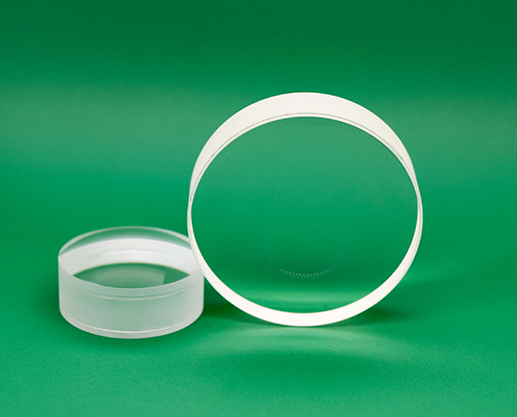
How Does an Achromatic Doublet Work?
An achromatic doublet normally combines glasses with different Abbe numbers.
The Abbe number is a measure of optical dispersion. A high Abbe number indicates relatively low dispersion, while a lower Abbe number indicates greater variation of refractive index with wavelength.
Crown glass generally has:
Lower refractive index
Higher Abbe number
Lower dispersion
Flint glass generally has:
Higher refractive index
Lower Abbe number
Higher dispersion
A common achromatic design combines a positive crown element and a negative flint element. The positive element provides most of the focusing power, while the negative element compensates for part of its chromatic error.
N-BK7 and N-SF5 are examples of crown and flint optical glasses that may be considered in achromatic optical designs. Their optical constants and material properties are documented for use in precision optical calculations.
The exact glass combination depends on:
Operating wavelength range
Required focal length
Lens diameter
Numerical aperture
Thermal requirements
Chemical durability
Transmission requirements
Manufacturing feasibility
Cost targets
Standard visible achromatic doublets are often optimized using representative blue, yellow, and red spectral lines at approximately 486.1, 587.6, and 656.3 nm.
Achromatic Lens vs Singlet Lens
A singlet lens contains one optical element, while a conventional achromatic doublet contains two elements with complementary dispersion.
| Performance factor | Singlet lens | Achromatic doublet |
|---|---|---|
| Number of elements | One | Usually two |
| Chromatic correction | Limited | Substantially improved |
| Broadband imaging | Basic performance | Better image sharpness |
| Spherical aberration | Depends on shape and orientation | Can be reduced through doublet optimization |
| Off-axis performance | Often more limited | Frequently improved |
| Weight and size | Usually lower | Slightly higher |
| Number of optical surfaces | Two | Commonly three when cemented |
| Cost | Lower | Higher |
| White-light applications | Suitable for less demanding systems | Preferred for precision imaging |
| Multiple wavelengths | Focus may change significantly | More consistent focal position |
Comparative optical modeling shows that achromatic doublets can produce a smaller broadband focal spot and better off-axis performance than comparable spherical singlets.
A singlet may still be the better option when:
Only one narrow wavelength is used
Image quality requirements are moderate
Space and weight must be minimized
Cost is the primary consideration
The lens has a low numerical aperture
Chromatic focus shift is not important
An achromatic lens is more appropriate when the system uses broadband light or multiple wavelengths and requires stable image quality.
Cemented and Air-Spaced Achromatic Lenses
Cemented Achromatic Doublets
In a cemented achromatic doublet, the two lens elements are bonded together using an optical adhesive.
This construction provides several advantages:
Compact assembly
Fewer air-to-glass interfaces
Easier mechanical mounting
Reduced risk of element decentration
Lower internal reflection than a comparable air-spaced design
Stable spacing between elements
A cemented achromat commonly has three effective optical interfaces rather than four because the two internal surfaces are joined.
However, the adhesive can limit operating temperature, ultraviolet transmission, chemical resistance, and laser damage performance. Differential thermal expansion between the two glasses and the cement must also be considered.
Air-Spaced Achromatic Doublets
An air-spaced achromat contains two separate lens elements held at a controlled distance from each other.
Advantages may include:
No optical cement in the beam path
Greater suitability for some ultraviolet systems
Potentially higher laser-power capability
More freedom to optimize aberrations
Better tolerance of certain temperature conditions
Easier replacement of individual elements
The disadvantages include additional reflections, more complex mounting, tighter spacing tolerances, and greater sensitivity to element tilt and decentration.
Air-spaced designs are normally selected when their performance or environmental benefits justify the added mechanical complexity.
Positive and Negative Achromatic Lenses
Positive Achromatic Doublets
Positive achromatic lenses have a positive focal length and converge an incoming collimated beam.
They are commonly used for:
Imaging
Beam focusing
Collimation
Relay optics
Microscopy
Telescopes
Spectroscopy
Fiber coupling
Laser beam expansion systems
A positive achromat generally combines a positive crown element with a negative flint element, with the total optical power remaining positive.
Negative Achromatic Doublets
Negative achromatic lenses have a negative focal length and cause a collimated beam to diverge.
They may be used in:
Beam expanders
Image-reduction systems
Telephoto optical arrangements
Laser beam shaping
Optical testing equipment
Multi-element imaging assemblies
Negative achromats also reduce wavelength-dependent divergence compared with a negative singlet.
Achromatic Lens Orientation
Achromatic lenses are often designed for a particular conjugate condition. Installing the lens in the wrong orientation can increase spherical aberration and reduce image quality.
Many standard positive achromatic doublets are optimized for infinite conjugate use. This means one side of the optical system is effectively at infinity, so the lens receives or produces a collimated beam.
When focusing a collimated beam, the more strongly curved side of many positive achromats is generally oriented toward the collimated beam, while the flatter side faces the focus. For collimating light from a point source, the orientation is reversed.
The correct orientation must ultimately be confirmed from the manufacturer’s drawing or optical model because not every achromatic design has the same surface configuration.
For finite-conjugate imaging, the object distance and image distance should be considered during lens selection. A lens optimized for infinite conjugates may not provide the best performance in a 1:1 imaging system.
Achromatic Lenses for Different Wavelength Ranges
Achromatic correction is not universal across the complete optical spectrum. Each lens is designed for a particular wavelength range.
Visible Achromatic Lenses
Visible achromats are commonly optimized for applications operating across approximately the visible spectrum.
Typical applications include:
White-light imaging
Machine vision
Microscopy
Inspection systems
Projection
Color measurement
Visible spectroscopy
Standard visible achromatic doublets may use design wavelengths around 486.1, 587.6, and 656.3 nm and antireflection coatings covering approximately 400–700 nm.
Near-Infrared Achromatic Lenses
Near-infrared achromats use glass combinations and coatings selected for longer wavelengths.
They may be used in:
Near-infrared imaging
Laser systems
Semiconductor inspection
Night-vision instruments
NIR spectroscopy
Optical sensing
Beam delivery
An achromat designed for visible light should not automatically be used in the near-infrared. The glass transmission, chromatic correction, focal length, and coating performance may all differ.
Telecom Achromatic Lenses
Telecommunications achromats are designed for wavelengths used in fiber-optic communication and related photonic systems.
Some standard telecom achromats are optimized around representative wavelengths such as 1016, 1330, and 1550 nm, with broadband coatings selected for the corresponding near-infrared region.
Typical applications include:
Fiber collimation
Receiver optics
Optical testing
Beam expansion
Free-space communication
Telecom component characterization
Ultraviolet Achromatic Lenses
UV achromats require optical materials and adhesives that transmit the target ultraviolet range.
Standard crown and flint glasses may absorb shorter ultraviolet wavelengths. UV designs may therefore use fused silica, calcium fluoride, specialized glass, air-spaced constructions, or specially selected optical cements.
The intended wavelength must be stated before material and coating selection.
Achromatic Lenses vs Apochromatic Lenses
An achromatic lens is typically corrected so that two wavelengths share approximately the same focal point.
An apochromatic lens provides more advanced correction, commonly bringing three wavelengths to a common focus while also reducing secondary spectrum.
| Requirement | Achromatic lens | Apochromatic lens |
|---|---|---|
| Main color correction | Typically two wavelengths | Typically three wavelengths |
| Secondary spectrum | Reduced but remains | More strongly reduced |
| Number of elements | Usually two | Often three or more |
| Design complexity | Moderate | Higher |
| Size and weight | Relatively compact | May be greater |
| Cost | More economical | More expensive |
| General broadband imaging | Very suitable | Used for more demanding color correction |
| High-end microscopy or imaging | Often sufficient | Preferred when residual color is critical |
An achromatic doublet is generally the more cost-effective choice for industrial imaging, laboratory equipment, and broadband illumination systems where excellent but not extreme chromatic correction is required.
Achromatic Lenses vs Aspheric Lenses
An aspheric lens uses a non-spherical surface to reduce spherical aberration. However, a conventional single-material asphere does not necessarily correct chromatic aberration.
The selection depends on the system requirement:
Choose an achromatic doublet when broadband color correction is the primary concern.
Choose an aspheric singlet when monochromatic spherical-aberration correction and compact size are more important.
Consider an aspherized achromat when both chromatic and spherical aberration must be tightly controlled.
Aspherized achromatic lenses combine the color correction of an achromat with an aspheric surface designed to improve high-numerical-aperture performance. They can be useful in relay systems, condensers, laser beam expanders, and demanding imaging applications.
Important Achromatic Lens Specifications
Lens Diameter
The diameter must be large enough to transmit the required beam without excessive clipping.
Buyers should distinguish between:
Mechanical diameter
Clear aperture
Effective optical diameter
A lens may have a clear aperture equal to only part of its full outside diameter because the edge area is required for mounting, beveling, or manufacturing.
Effective Focal Length
Effective focal length determines the optical power of the achromatic lens.
A shorter focal length generally produces stronger focusing and a higher numerical aperture for a given diameter. It may also increase sensitivity to alignment, aberrations, and manufacturing tolerances.
Back Focal Length
Back focal length is the distance from the final optical surface to the focal plane.
This value is essential for mechanical integration because it determines the available space between the lens and the detector, fiber, sample, or image plane.
Numerical Aperture and F-Number
Numerical aperture describes the range of angles that a lens can accept or emit. A higher numerical aperture supports greater light collection and potentially smaller focal spots, but it also increases sensitivity to aberrations.
F-number is approximately the ratio of focal length to clear aperture for a lens operating in air.
Buyers should not select a lens based only on focal length. Two lenses with the same focal length but different diameters can have very different numerical apertures and imaging performance.
Design Wavelengths
The specified design wavelengths indicate where the chromatic correction has been optimized.
A visible achromat may perform well at blue, green, and red reference wavelengths but may not maintain the same correction in the ultraviolet or near-infrared.
Antireflection Coating
A cemented achromatic doublet usually has multiple glass-air surfaces that generate Fresnel reflections.
An antireflection coating can:
Increase transmission
Reduce ghost images
Improve image contrast
Reduce laser feedback
Improve weak-signal detection
Reduce stray light
The coating must match the operating wavelength, angle of incidence, polarization, environmental requirements, and laser power.
Surface Quality
Surface quality is commonly specified using scratch-dig values, such as:
80-50
60-40
40-20
20-10
10-5
Lower values represent stricter cosmetic quality.
Tighter surface quality may be required for high-power lasers, low-scatter imaging, microscopy, or systems with a focal plane near the lens.
Surface Accuracy
Surface power and irregularity describe how closely each optical surface follows its specified curvature.
Errors in surface figure can increase wavefront error, enlarge focal spots, and reduce imaging resolution.
Centration
Centration describes the relationship between the optical axes of the lens surfaces and the mechanical axis of the finished component.
Poor centration can introduce:
Coma
Image shift
Beam deviation
Uneven image quality
Reduced system resolution
Precision commercial achromatic doublets may specify centration errors of only a few arcminutes.
Focal-Length Tolerance
The actual focal length of a manufactured lens varies within a defined tolerance.
In applications involving fixed detector positions, fiber coupling, compact housings, or replaceable optical modules, focal-length tolerance can directly affect assembly yield and focusing accuracy.
Edge Thickness and Center Thickness
The total lens thickness affects:
Mechanical installation
Weight
Optical path length
Lens-holder design
Adhesive area
Resistance to handling damage
The edge may also include a bevel or chamfer to reduce chipping.
Common Applications of Achromatic Lenses
Machine Vision
Machine-vision systems often use broadband LED illumination and color or monochrome cameras.
Achromatic lenses help maintain focus across the illumination spectrum, improving edge definition, dimensional measurement, defect recognition, and color inspection.
Microscopy
Achromatic lenses are used in microscope objectives, relay systems, illumination paths, and imaging modules.
They help reduce color fringes and maintain a more consistent image plane across visible wavelengths.
Spectroscopy
Spectrometers frequently handle broad wavelength ranges and weak optical signals.
Achromatic lenses may be used to:
Collect light from a source
Focus light onto a slit
Collimate a broadband beam
Couple light into an optical fiber
Focus dispersed light onto a detector
The corrected wavelength range and coating must match the spectrometer band.
Laser Beam Expanders
An achromatic negative-positive lens combination can expand or reduce a laser beam while maintaining more consistent performance across multiple wavelengths.
This is useful for alignment systems, multi-wavelength lasers, fluorescence equipment, and tunable sources.
Fluorescence Imaging
Fluorescence instruments frequently use different excitation and emission wavelengths.
Achromatic lenses reduce the need to refocus when switching between wavelengths and help maintain alignment between the illumination and detection paths.
Telescopes and Binoculars
Achromatic objectives are commonly used to reduce the colored fringes produced by simple refracting lenses.
For high-end astronomical observation, residual secondary spectrum may still be visible, so apochromatic objectives may be selected instead.
Optical Sensors
Achromatic lenses can focus broadband light onto photodiodes, line sensors, camera chips, spectrometer slits, and fiber inputs.
Stable focal position across wavelength can improve signal consistency and calibration accuracy.
Common Selection and Purchasing Mistakes
Assuming Every Achromat Covers the Same Spectrum
A visible achromatic lens, an NIR achromat, and a telecom achromat may have similar dimensions but very different glass types, coatings, and chromatic performance.
Always specify the complete operating band.
Selecting Only by Focal Length
Focal length alone does not define numerical aperture, clear aperture, aberration control, working distance, or imaging performance.
Diameter, f-number, conjugate ratio, and field of view must also be evaluated.
Installing the Lens Backwards
Incorrect orientation can increase spherical aberration and enlarge the focal spot.
The manufacturer’s drawing should identify the recommended orientation.
Ignoring the Conjugate Ratio
A standard infinite-conjugate achromat may not provide the best performance in a finite-conjugate imaging system.
The object distance, image distance, and required magnification should be included in a custom inquiry.
Using the Coating Outside Its Designed Band
An AR coating optimized for visible light may reflect strongly in the NIR. It may also change focal behavior through wavelength-dependent transmission losses.
Over-Specifying Cosmetic Quality
A very tight scratch-dig specification may add cost without improving performance in a general illumination system.
Specifications should reflect the actual beam size, image requirement, laser power, and acceptable stray light.
Ignoring Cement Limitations
Cemented doublets may not be suitable for every UV, high-temperature, vacuum, chemical, or high-power laser environment.
The operating conditions should be reviewed before finalizing the construction.
Information to Provide for a Custom Achromatic Lens
A complete request for quotation should include:
| Specification | Information to provide |
|---|---|
| Application | Imaging, focusing, collimation, spectroscopy or beam expansion |
| Wavelength range | Minimum, maximum and important design wavelengths |
| Lens type | Positive, negative, cemented, air-spaced or aspherized |
| Dimensions | Diameter, center thickness and mechanical limits |
| Focal properties | Effective focal length, back focal length and working distance |
| Conjugate condition | Infinite, finite or specified object and image distances |
| Numerical aperture | Required NA, f-number or beam diameter |
| Field requirement | Field of view or maximum off-axis angle |
| Glass restrictions | Preferred or prohibited optical materials |
| Surface quality | Required scratch-dig value |
| Wavefront | Permitted transmitted wavefront error |
| Centration | Maximum wedge or optical-axis error |
| Coating | Spectral band, reflectance and angle of incidence |
| Environment | Temperature, humidity, vacuum, chemicals or vibration |
| Laser information | Wavelength, power, pulse duration and beam diameter |
| Quantity | Prototype, pilot batch or production volume |
| Documentation | Material, dimensional, coating or interferometric report |
For imaging applications, providing the sensor size, pixel size, object distance, image distance, magnification, and required resolution can help the manufacturer evaluate the design more accurately.
How to Evaluate an Achromatic Lens Supplier
A capable supplier should be able to manage material selection, optical design, precision processing, assembly, coating, and inspection.
Buyers should evaluate whether the supplier can provide:
Optical design and tolerance analysis
Appropriate crown and flint glass selection
Precision spherical polishing
Reliable cementing or air-spaced assembly
Accurate centration control
Broadband and laser-line AR coatings
Surface-quality inspection
Focal-length measurement
Transmitted wavefront testing
Environmental testing when required
Custom mounting or barrel assembly
Prototype and production-volume support
Batch inspection documentation
For custom achromatic lenses, manufacturing tolerances should be included in the optical model before tooling and production begin. A nominal design that performs well in software may become difficult or expensive to manufacture if tolerances are not analyzed.
Frequently Asked Questions
What does an achromatic lens correct?
An achromatic lens primarily reduces chromatic aberration. Many achromatic doublets are also optimized to reduce spherical aberration compared with a basic singlet.
How many wavelengths does an achromatic lens correct?
A conventional achromatic lens normally brings two selected wavelengths to approximately the same focal point while reducing focal variation across the wavelengths between them.
Is every achromatic lens a doublet?
No. Most standard achromats are doublets, but an achromatic lens can also use three or more elements.
What is the difference between crown and flint glass?
Crown glass generally has lower dispersion and a higher Abbe number. Flint glass generally has higher dispersion and a lower Abbe number. Combining their opposite chromatic effects helps reduce color error.
Are achromatic lenses suitable for lasers?
Yes. They can be used for single-wavelength and multi-wavelength laser applications. The glass, coating, cement, surface quality, and laser damage threshold must match the laser parameters.
Can achromatic lenses be used in the infrared?
Yes, provided the lens is specifically designed with IR-transmitting materials and a suitable antireflection coating.
Do achromatic lenses eliminate all chromatic aberration?
No. They substantially reduce primary chromatic aberration but normally retain some secondary spectrum and other residual aberrations.
Should the crown or flint element face the collimated beam?
The correct orientation depends on the individual design. For many positive infinite-conjugate achromats, the more strongly curved side faces the collimated beam, but the manufacturer’s drawing should always be followed.
What is the difference between an achromat and an apochromat?
An achromat typically corrects two wavelengths, while an apochromat provides stronger correction across three wavelengths and reduces secondary color more effectively.
Can custom achromatic lenses be manufactured?
Yes. Diameter, focal length, glass combination, wavelength correction, numerical aperture, coating, edge geometry, surface quality, centration, and mounting structure can all be customized.
Conclusion
Achromatic lenses provide a practical and cost-effective method for reducing the color-dependent focus errors produced by conventional singlet lenses.
By combining optical glasses with different refractive indices and dispersion characteristics, an achromatic doublet can bring two selected wavelengths to a common focal region and improve image quality across a broader spectrum. This produces sharper broadband images, smaller focal spots, more consistent beam propagation, and better multi-wavelength system performance.
However, not every achromatic lens is suitable for every optical system. The operating wavelength, lens diameter, focal length, numerical aperture, conjugate ratio, glass combination, coating, surface quality, centration, orientation, and environment must be considered together.
For standard applications, a catalog achromatic doublet may provide an efficient solution. For demanding imaging, spectroscopy, laser, sensing, or instrumentation projects, a customized achromatic lens designed around the complete optical path can provide more reliable performance and reduce system-level alignment and correction requirements.