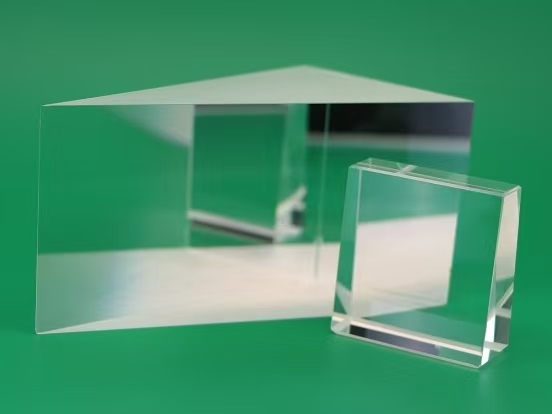










The difference between beam splitting with a prism and beam turning with a right-angle prism
Jan. 16, 2026
In optics, prisms are core components, used for light path manipulation and spectral splitting through refraction and reflection. Prism beam splitting and right-angle prism reversal are two typical applications of prisms, fundamentally different in their core principles, structural design, and functional positioning.
I. Core Principles: Dispersion Splitting vs. Total Internal Reflection Reversal
The fundamental difference lies in their different operating principles, directly determining their functional orientation.
Prism beam splitting relies on light dispersion: different wavelengths of light have different refractive indices in the same medium. When polychromatic light enters a prism, it undergoes two refractions, resulting in different deflection angles, ultimately splitting into monochromatic lights arranged according to wavelength, forming a spectrum. The core principle is utilizing the difference in refractive index to split polychromatic light.
Right-angle prism reversal relies on total internal reflection: light enters the prism in a specific direction, undergoes total internal reflection at the reflecting interface, and then exits from the exit surface, achieving a change in propagation direction. The entire process only changes the light path, without producing dispersion; the composition of the polychromatic light remains unchanged. The core principle is controlling the light path through total internal reflection without altering the spectral characteristics of the light.
II. Structural Design: Targeted Construction Based on Adaptation Principles
Structure serves function; the designs of both are based on their respective principles and differ significantly.
Prisms are mostly symmetrical triangles, with all three faces being optical planes. The angle between the refractive surfaces directly affects the dispersion effect. The material must balance refractive index stability and dispersion capability; high-dispersion optical materials are commonly used to enhance the difference in light refraction.
Right-angle prisms are special right-angled triangles. The two right-angled faces handle the incident and emitted light, while the hypotenuse is the reflecting surface (requiring special treatment to enhance reflection). The core design goal is to ensure that the incident light meets the conditions for total internal reflection. The material selection prioritizes light transmittance and mechanical stability; conventional optical materials are sufficient.
III. Functional Positioning: Spectral Analysis vs. Optical Path Control
The differences in principle and structure clearly differentiate their functional positioning.
The core function of a prism is to separate polychromatic light and perform spectral analysis. It can convert mixed light into monochromatic light, obtain spectral information such as the composition of the light source, and can also be used in spectral-related equipment to filter light of specific wavelengths.
The core function of a right-angle prism is to control the direction of light propagation without changing other properties of the light. It can avoid spatial interference of optical components, optimize the system structure, and ensure that light propagates along a preset path.
IV. Other Key Differences
Besides the core dimensions, the two also differ significantly in terms of light intensity loss, applicable light sources, and accuracy requirements:
Light Intensity Loss: A triangular prism experiences greater light intensity loss due to double refraction; a right-angle prism relies on total internal reflection, resulting in only minor loss at the incident and exit interfaces, leading to a smaller overall loss.
Applicable Light Sources: Triangular prisms are primarily suitable for polychromatic light and cannot separate monochromatic light; right-angle prisms have no special requirements for light sources and are suitable for both monochromatic and polychromatic light.
Accuracy Requirements: Triangular prisms emphasize the uniformity of material dispersion and the flatness of the optical surface to avoid spectral blurring; right-angle prisms emphasize the flatness of the reflecting surface and angular accuracy to ensure stable and accurate steering.
In practical optical system design, the appropriate prism type must be selected based on specific requirements: if spectral information of light needs to be obtained, a triangular prism should be used to achieve beam splitting; if the direction of the light path needs to be adjusted and the system structure optimized, a right-angle prism should be used to achieve steering. Understanding the difference between these two is fundamental to the rational application of prism elements and the design of efficient optical systems.