


Applications of Right Angle Prisms in Laser and Imaging Systems
Jan. 13, 2026
Right angle prisms are among the most widely used optical components in laser systems and imaging instruments. Thanks to their compact geometry, high optical efficiency, and ability to precisely redirect light, they play a critical role in modern optical system design.
From industrial lasers to scientific imaging and machine vision, right angle prisms are essential for beam steering, optical path folding, and image manipulation. This article explores the key applications of right angle prisms in laser and imaging systems, explaining why they are often preferred over mirrors or other prism types.
Why Right Angle Prisms Are Ideal for Laser and Imaging Systems
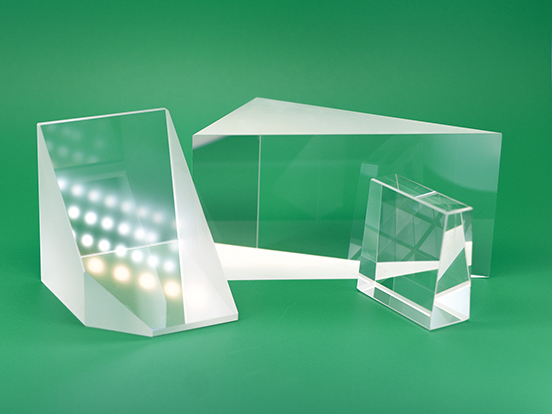
A right angle prism is a triangular prism with a 90° angle that can redirect light by 90° or 180° using total internal reflection (TIR) or reflective coatings.
Key advantages include:
High reflectivity without metallic coatings (via TIR)
Excellent beam pointing stability
Compact and rigid optical alignment
Broad wavelength compatibility (UV, visible, IR)
Long-term durability in industrial environments
These properties make right angle prisms particularly well suited for precision laser optics and imaging assemblies.
Applications in Laser Systems
1. Laser Beam Steering and Direction Control
One of the most common uses of right angle prisms in laser systems is beam steering.
Redirects laser beams by exactly 90°
Maintains beam quality and polarization
More stable than mirror mounts in vibration-prone environments
Typical laser applications include:
Industrial cutting and marking lasers
Medical laser delivery systems
Scientific research lasers
Compared to mirrors, right angle prisms offer fixed angular accuracy and improved mechanical robustness.
2. Optical Path Folding in Compact Laser Designs
In compact laser modules, available space is often limited. Right angle prisms allow designers to fold optical paths efficiently without increasing system size.
Used in:
OEM laser modules
Fiber-coupled laser systems
Portable laser instruments
By folding the beam path, system designers can:
Reduce enclosure size
Improve optical layout efficiency
Maintain alignment stability
3. Retroreflection and Beam Reversal
When a laser beam enters the hypotenuse face, a right angle prism can reflect the beam back parallel to its original path (180° deviation).
This is widely used in:
Laser interferometers
Alignment and calibration systems
Optical delay lines
Retroreflection using a right angle prism is more stable than mirror-based solutions.
4. High-Power Laser Applications
Right angle prisms are suitable for high-power laser systems when made from appropriate materials such as:
UV fused silica
Optical-grade BK7
IR materials like CaF₂ or ZnSe
Because TIR does not rely on reflective coatings, right angle prisms:
Offer higher laser damage thresholds
Reduce coating failure risks
This makes them ideal for high-energy pulsed and continuous-wave lasers.
Applications in Imaging Systems
1. Image Inversion and Reversion
Right angle prisms naturally invert or reverse images depending on orientation, making them useful in imaging optics for:
Correcting image orientation
Optical system layout optimization
Common imaging uses include:
Microscopy systems
Projection optics
Optical inspection equipment
2. Optical Path Folding in Imaging Devices
Just like in laser systems, right angle prisms help fold optical paths in imaging assemblies to reduce system size.
Used in:
Machine vision cameras
Medical imaging devices
Industrial inspection systems
Compact folded designs are especially valuable in:
Embedded vision systems
Portable imaging equipment
3. Beam Splitting and Combination (with Coatings)
When combined with partial reflective coatings, right angle prisms can function as:
Beam combiners
Beam splitters
This is common in:
Interferometric imaging
Optical measurement systems
Alignment and metrology tools
4. Precision Alignment in Imaging Systems
Right angle prisms provide:
Fixed angular relationships
Repeatable beam deviation
This improves:
System alignment accuracy
Long-term optical stability
As a result, they are widely used in high-precision imaging and measurement instruments.
Material and Coating Choices for Laser & Imaging Use
To perform reliably, right angle prisms must be matched to system requirements:
Common Materials
BK7: visible imaging and general lasers
UV fused silica: UV lasers and high-power applications
CaF₂ / MgF₂: UV and deep-UV imaging
ZnSe / Ge: IR and CO₂ laser systems
Coating Options
AR coatings on entrance/exit faces
Uncoated hypotenuse for TIR
Metallic or dielectric coatings for non-TIR designs
Proper material and coating selection ensures maximum transmission, minimal loss, and long-term durability.
Right Angle Prisms vs Mirrors in Laser and Imaging Systems
Compared to mirrors, right angle prisms offer:
Higher mechanical stability
No need for mirror alignment mounts
Better resistance to environmental changes
Improved repeatability in OEM assemblies
This is why many laser and imaging manufacturers prefer right angle prisms in fixed optical architectures.
Typical Industries Using Right Angle Prisms
Industrial laser processing
Medical and biomedical imaging
Machine vision and automation
Scientific research and spectroscopy
Metrology and optical inspection
Their versatility makes them a standard component across multiple optical industries.
Conclusion
Right angle prisms are indispensable components in laser and imaging systems, offering reliable beam steering, compact optical path folding, and excellent long-term stability. Whether used in high-power laser applications or precision imaging instruments, they deliver a strong balance of performance, durability, and cost efficiency.
For optical engineers and OEM manufacturers, right angle prisms remain one of the most practical and widely adopted solutions in modern optical system design.