


Differences Between Right Angle Prisms and Other Optical Prisms
Jan. 13, 2026
Optical prisms are essential components in modern optical systems, used to redirect light, invert images, fold optical paths, and disperse wavelengths. Among them, the right angle prism is one of the most widely used prism types due to its simple geometry and versatile functionality.
However, right angle prisms differ significantly from other optical prisms in design, optical behavior, and application scope. This article provides a clear and practical comparison between right angle prisms and other common optical prisms, helping optical engineers, OEMs, and system designers choose the most suitable prism for their applications.
What Is a Right Angle Prism?
A right angle prism is a triangular prism with one 90° angle and two 45° angles. It is typically used to:
Deviate a light beam by 90°
Reflect light by 180°
Invert or reverse images
Right angle prisms rely on either total internal reflection (TIR) or reflective coatings to achieve high-efficiency beam redirection.
How a Right Angle Prism Works
Depending on beam entry and orientation, a right angle prism can perform different optical functions:
90° beam deflection: Light enters one short face and exits the hypotenuse.
180° retroreflection: Light enters the hypotenuse and exits the same face after two internal reflections.
Image inversion or rotation: Used in imaging systems to correct orientation.
The ability to perform multiple functions with a single prism makes right angle prisms extremely popular in compact optical designs.
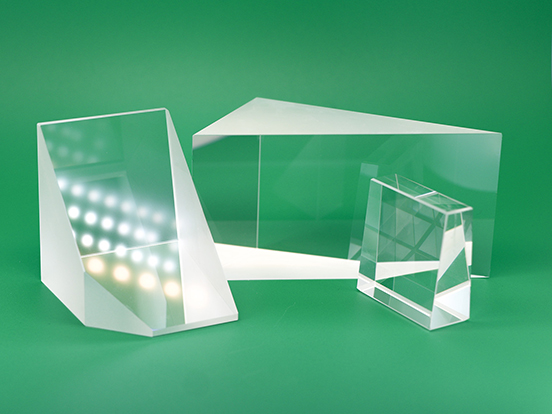
Overview of Other Common Optical Prisms
Before comparing, it is important to understand the role of other widely used prisms:
Equilateral (Dispersive) Prisms
Designed primarily for spectral dispersion
Separate white light into component wavelengths
Common in spectroscopy and wavelength analysis
Porro Prisms
Used for image inversion and beam displacement
Common in binoculars and optical viewing systems
Dove Prisms
Rotate images when the prism itself is rotated
Used in image rotation and alignment systems
Penta Prisms
Provide fixed 90° beam deviation regardless of orientation
Widely used in surveying instruments and cameras
Amici (Roof) Prisms
Erect images while maintaining optical path alignment
Used in spotting scopes and telescopes
Key Differences: Right Angle Prisms vs. Other Optical Prisms
1. Optical Functionality
Right angle prisms are primarily used for:
Beam folding
Path redirection
Image inversion
Other prisms are often function-specific, such as:
Dispersion (equilateral prism)
Image rotation (Dove prism)
Fixed-angle deviation (penta prism)
This makes right angle prisms more versatile but less specialized.
2. Beam Deviation Accuracy
Right angle prisms provide accurate 90° or 180° beam deviation but are sensitive to alignment.
Penta prisms maintain precise 90° deviation regardless of prism rotation, offering higher angular stability.
For applications requiring angular insensitivity, penta prisms outperform right angle prisms.
3. Image Orientation Effects
Right angle prisms can:
Invert images
Reverse left-right orientation
Other prisms provide more controlled image manipulation:
Porro prisms flip images in two axes
Amici prisms erect images
Dove prisms rotate images continuously
Thus, imaging systems often use non-right-angle prisms for precise image control.
4. Use of Total Internal Reflection (TIR)
Right angle prisms often utilize TIR, offering:
High reflectivity without coatings
Excellent performance across broad wavelengths
In contrast:
Some prisms require mirror coatings
Coating performance may vary by wavelength
This gives right angle prisms an advantage in laser and broadband optical systems.
5. Size, Simplicity, and Cost
Right angle prisms feature:
Simple geometry
Compact design
Lower manufacturing cost
Other prisms, such as penta or roof prisms:
Require tighter angular tolerances
Are more complex to manufacture
Typically cost more
This makes right angle prisms attractive for cost-sensitive OEM applications.
Application Comparison
Typical Applications of Right Angle Prisms
Laser beam steering
Optical path folding in compact instruments
Interferometers
Industrial inspection systems
Typical Applications of Other Optical Prisms
Spectrometers (equilateral prisms)
Binoculars and telescopes (Porro, roof prisms)
Surveying equipment (penta prisms)
Image rotation systems (Dove prisms)
Material and Coating Considerations
Both right angle prisms and other prisms can be manufactured from:
Optical glass (BK7, B270)
UV fused silica
IR materials (CaF₂, ZnSe, Ge)
However, right angle prisms often benefit more from:
Uncoated hypotenuse faces (for TIR)
AR coatings on entrance and exit faces
Other prisms may require:
High-reflective coatings
Roof edge precision
Specialized dispersion optimization
Choosing the Right Prism for Your Optical System
When deciding between a right angle prism and other optical prisms, consider:
Required beam deviation angle
Image orientation needs
Alignment sensitivity
Wavelength range
Cost and size constraints
Choose a right angle prism if:
You need simple beam redirection
System design requires compactness
Cost efficiency is important
Choose other optical prisms if:
You need precise image erection or rotation
Angular deviation must remain constant
Spectral dispersion is required
Conclusion
Right angle prisms stand out for their versatility, simplicity, and cost-effectiveness, making them one of the most commonly used optical prisms. However, they are not always the best choice for applications requiring precise image control, angular stability, or spectral analysis.
Understanding the differences between right angle prisms and other optical prisms allows optical engineers and system designers to select the optimal component for performance, reliability, and cost.