


Plano-Concave Lenses for UV and IR Applications: Materials, Performance, and Design Considerations
Jan. 13, 2026
Plano-concave lenses are widely used optical components for beam expansion, divergence control, and aberration correction. In ultraviolet (UV) and infrared (IR) applications, however, lens selection becomes more complex due to wavelength sensitivity, material transmission limits, and coating requirements.
This article provides a comprehensive overview of plano-concave lenses for UV and IR applications, focusing on material options, optical performance, typical use cases, and key factors engineers should consider when specifying lenses for short- and long-wavelength systems.
What Is a Plano-Concave Lens?
A plano-concave lens consists of:
One flat (plano) surface
One inward-curving concave surface
It is a negative focal length lens, primarily used to:
Diverge collimated light
Expand laser beams
Reduce focal length in optical systems
Correct spherical aberration when paired with positive lenses
Plano-concave lenses are commonly used in laser optics, spectroscopy, imaging systems, and scientific instruments, especially where beam shaping and wavelength control are critical.
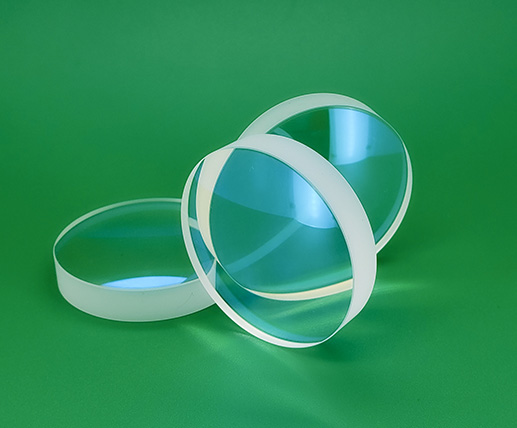
Why UV and IR Applications Require Specialized Plano-Concave Lenses
Standard optical glass performs well in the visible spectrum but often fails in UV or IR ranges due to:
Poor transmission
High absorption
Thermal instability
Surface degradation
For UV and IR systems, material transparency and coating compatibility become the most important selection criteria.
Plano-Concave Lenses for UV Applications
UV Wavelength Ranges
Near-UV (NUV): 300–400 nm
Deep UV (DUV): 190–300 nm
Vacuum UV (VUV): <190 nm
Each UV range demands different optical materials.
Common Materials for UV Plano-Concave Lenses
Fused Silica (UV Grade)
Excellent transmission from ~180 nm to 2.2 μm
Low fluorescence
High laser damage threshold
Excellent thermal stability
Typical UV applications:
UV laser beam expanders
Photolithography
UV spectroscopy
Semiconductor inspection
Calcium Fluoride (CaF₂)
High transmission down to ~130 nm
Extremely low absorption in deep UV
Low refractive index
Ideal for:
Excimer lasers
DUV imaging systems
High-precision UV optics
Magnesium Fluoride (MgF₂)
Transmission down to ~120 nm
High resistance to UV-induced degradation
Often used in:
Vacuum UV systems
Space and aerospace optics
UV Coating Considerations
For UV optics, coatings must:
Maintain low absorption
Avoid solarization
Withstand high photon energy
Common UV coatings include:
UV MgF₂ anti-reflection coatings
Deep UV broadband AR coatings
In some high-power UV systems, uncoated fused silica lenses are still used to avoid coating damage.
Plano-Concave Lenses for IR Applications
IR Wavelength Ranges
Near-IR (NIR): 0.75–2.5 μm
Mid-IR (MIR): 3–5 μm
Long-Wave IR (LWIR): 8–14 μm
Material choice varies significantly across these ranges.
Common Materials for IR Plano-Concave Lenses
Infrared Fused Silica (NIR)
Good transmission up to ~2.2 μm
High durability and low thermal expansion
Applications:
NIR imaging
Fiber laser systems
Industrial sensing
Silicon (Si)
Transmission from ~1.2 μm to 8 μm
High refractive index
Excellent thermal conductivity
Used in:
Mid-IR optics
Thermal imaging
CO₂ laser pre-alignment
Germanium (Ge)
Transmission from ~2 μm to 14 μm
High refractive index
Sensitive to temperature changes
Common IR uses:
Thermal cameras
LWIR imaging systems
Military and surveillance optics
Zinc Selenide (ZnSe)
Wide transmission range: 0.6–20 μm
Low absorption at 10.6 μm
Ideal for:
CO₂ laser beam expanders
High-power IR laser systems
IR Coating Options
IR plano-concave lenses often use:
BBAR coatings for IR ranges
DLC coatings for durability
Anti-reflection coatings optimized for CO₂ laser wavelengths
Proper coating selection improves transmission and reduces thermal lensing effects.
Plano-Concave Lens Orientation: A Critical Design Detail
For optimal performance:
The curved surface should face the collimated beam
The plano surface should face the focal point
This orientation:
Minimizes spherical aberration
Improves beam quality in UV and IR systems
This principle is widely cited in top-ranking optics manufacturer documentation.
Typical Applications of UV & IR Plano-Concave Lenses
UV Applications
UV laser beam expansion
Fluorescence imaging
UV curing systems
Semiconductor lithography
IR Applications
Thermal imaging systems
IR spectroscopy
CO₂ laser optics
Industrial sensing and monitoring
Key Buying Considerations for UV and IR Plano-Concave Lenses
When sourcing lenses, engineers should evaluate:
Target wavelength range
Transmission efficiency
Laser power and damage threshold
Environmental conditions (temperature, humidity)
Coating durability
Surface quality and scratch-dig specs
For OEM and industrial users, custom plano-concave lenses with optimized materials and coatings often deliver the best system performance.
Conclusion
Plano-concave lenses play a critical role in both UV and IR optical systems, but their performance depends heavily on material choice, coating design, and system integration.
UV applications prioritize high transmission and resistance to photon damage
IR applications demand thermal stability and wavelength-specific materials
By selecting the correct plano-concave lens material and coating, optical engineers can significantly improve system efficiency, reliability, and long-term performance.