










Right Angle Prisms: Structure, Functions, and Manufacturing Standards
Jul. 14, 2025
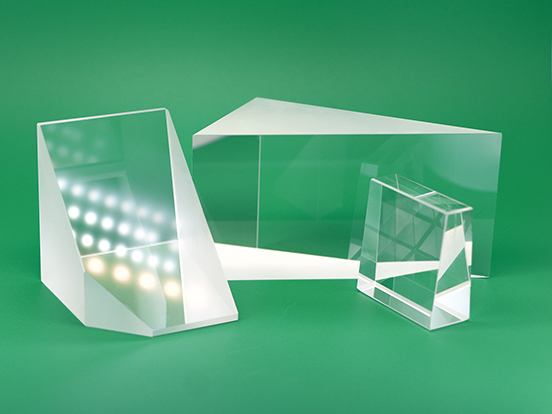
Right angle prisms are optical components designed to reflect light by 90° or 180°, depending on their orientation and the surface through which the light enters. These prisms feature two perpendicular legs and a hypotenuse face, forming a triangular geometry where all joining faces are rectangular and meet at right angles.
While many of the reflection functions can be achieved using plane mirrors, right angle prisms offer easier mounting, alignment, and long-term stability. When using the hypotenuse for external reflection, it can be enhanced with a metallic or dielectric reflective coating to increase efficiency.
Optical Surface Flatness
Flatness indicates how closely a prism surface conforms to an ideal flat plane. Using a high-precision optical flat interferometer, interference fringes are analyzed to detect curvature or deviation.
Flatness is expressed in lambda (λ) units:
1λ = One full wave
λ/4 = Precision-grade flatness
2 fringes = 1λ deviation
CLZ Optical guarantees λ/4 flatness @ 632.8 nm as standard, meeting the requirements of most precision applications.
Surface Quality
All right angle prisms are finished to a surface quality of 60-40 scratch-dig, in accordance with MIL-PRF-13830B. This precision-grade standard offers superior performance compared to the general 80-50 rating found in commercial optics.
Custom Options Available
If your project requires tighter tolerances, higher flatness precision, or custom coatings, CLZ Optical can provide tailored solutions. Our advanced facilities and experienced engineers are ready to meet your specialized optical requirements.
Contact CLZ Optical today to discuss your application needs or request a custom quote for high-quality right angle prisms.