


High Index Ball Lenses: Properties, Applications, Benefits, and Selection Guide
Aug. 12, 2026
High index ball lenses are compact spherical optical components made from materials with a relatively high refractive index. Because of their small size, strong focusing capability, and efficient light coupling performance, they are widely used in fiber optics, laser systems, optical communication devices, medical instruments, sensors, and miniature imaging systems.
Compared with conventional ball lenses made from standard optical glass, high index ball lenses can provide shorter focal lengths and stronger optical power within the same physical diameter. This makes them particularly useful when an optical system must remain compact while maintaining efficient focusing or coupling performance.
This article explains how high index ball lenses work, their key advantages, common applications, material options, important specifications, and how to select the right lens for an optical system.
What Is a High Index Ball Lens?
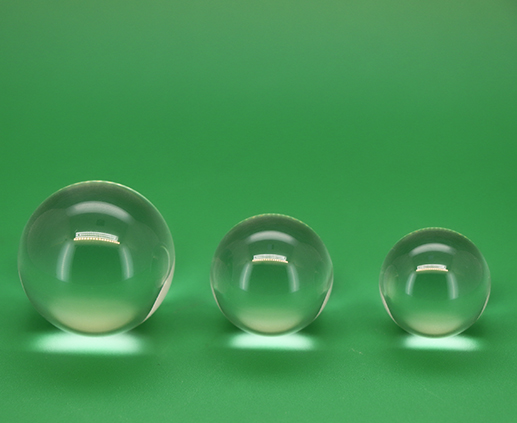
A high index ball lens is a fully spherical optical lens manufactured from a material with a high refractive index.
Unlike conventional plano-convex, bi-convex, or aspheric lenses, a ball lens has a complete spherical geometry. Light entering the lens is refracted through the curved surface and can be focused, collimated, or coupled depending on the optical configuration.
High index ball lenses are commonly manufactured from materials such as:
High-index optical glass
S-LAH series glass
LASFN optical glass
Sapphire
Specialized infrared optical materials
Other high-refractive-index glasses
The higher refractive index increases the optical power of the ball lens, making it possible to achieve a shorter effective focal length in a very small component.
How Do High Index Ball Lenses Work?
The focusing behavior of a ball lens depends largely on:
Ball diameter
Refractive index
Operating wavelength
Surrounding medium
Position of the incoming light source
When parallel light enters the spherical lens, refraction occurs at both the entrance and exit surfaces.
Because a high-index material bends light more strongly than standard optical glass, a high index ball lens generally produces a shorter focal distance than a lower-index ball lens of the same diameter.
This is especially useful when engineers need:
Compact optical packaging
Strong focusing power
Short working distances
Efficient optical coupling
Miniaturized optical assemblies
Why Use High Index Ball Lenses?
The main benefit of high index ball lenses is that they provide strong focusing performance in a very compact form.
1. Shorter Focal Length
A higher refractive index allows light to bend more strongly.
Therefore, compared with a lower-index ball lens of the same diameter, a high index ball lens can generally provide a shorter focal length.
This can help reduce overall system size.
2. Compact Optical Design
Miniaturization is increasingly important in:
Fiber optic modules
Optical sensors
Medical devices
Laser modules
Communication systems
Portable instruments
High index ball lenses are well suited to these applications because significant optical power can be achieved using a very small lens.
3. Efficient Fiber Coupling
High index ball lenses are frequently used to couple light between:
Laser diodes and optical fibers
Fibers and photodetectors
Two optical fibers
LEDs and fibers
Optical sources and sensors
Their spherical geometry and short focal characteristics make them suitable for precise light coupling.
4. Strong Light Focusing
High index materials make it possible to concentrate light into relatively small areas.
This can benefit applications requiring:
High optical intensity
Small focused spots
Precise beam delivery
Compact detector assemblies
5. Simple Mechanical Geometry
Unlike many multi-surface precision lenses, ball lenses have a rotationally symmetric spherical shape.
This can simplify mechanical mounting and reduce orientation requirements in certain optical assemblies.
High Index Ball Lens vs. Standard Ball Lens
The most important difference is the refractive index of the material.
| Feature | Standard Ball Lens | High Index Ball Lens |
|---|---|---|
| Refractive index | Moderate | Higher |
| Optical power | Moderate | Stronger |
| Focal length | Longer | Shorter |
| Compact system design | Good | Excellent |
| Fiber coupling | Suitable | Highly suitable |
| Light bending | Moderate | Strong |
| Miniature applications | Common | Especially suitable |
For systems where compact dimensions and strong optical power are priorities, high index ball lenses are often preferred.
High Index Ball Lens vs. Half Ball Lens
A half ball lens is essentially half of a spherical lens.
The two lens types serve somewhat different functions.
High Index Ball Lenses
Typical strengths include:
Strong focusing
Fiber coupling
Compact beam manipulation
Miniature optical systems
Half Ball Lenses
Typical strengths include:
Simplified mounting against flat surfaces
Imaging near detectors
Integration with optical windows
Reduced assembly height
The correct option depends on packaging requirements and optical geometry.
Common Materials for High Index Ball Lenses
Material selection significantly influences the performance of the lens.
High-Index Optical Glass
High-index optical glass is commonly selected when visible or near-infrared transmission is required.
Potential benefits include:
High refractive index
Good optical homogeneity
Reliable polishing performance
Suitable transmission across common optical wavelengths
Common high-index optical glasses may be used in communication, imaging, or sensing systems.
Sapphire Ball Lenses
Sapphire provides a combination of:
Relatively high refractive index
High hardness
Strong mechanical durability
Good thermal resistance
Broad transmission range
Sapphire ball lenses may be suitable for demanding environments where abrasion, heat, or mechanical stress is a concern.
Infrared Materials
Some applications require high-index ball lenses for infrared wavelengths.
Suitable materials may include specialized infrared glasses or crystalline materials selected for:
Transmission range
Refractive index
Thermal stability
Environmental resistance
Material choice should always be based on the actual operating wavelength.
Key Optical Parameters of High Index Ball Lenses
Several specifications determine whether a ball lens is suitable for a particular application.
Diameter
Ball lens diameter affects:
Mechanical size
Focal position
Optical power
Coupling geometry
Numerical aperture
Smaller ball lenses are widely used in miniature optical assemblies and fiber optic systems.
Refractive Index
Refractive index is one of the most important characteristics of a high index ball lens.
Higher refractive index generally results in stronger refraction and shorter focal length.
However, the lens should not be selected solely based on index.
Other factors such as:
Dispersion
Transmission
material availability
coating compatibility
thermal behavior
must also be considered.
Effective Focal Length
The effective focal length determines the focusing strength of the lens.
A shorter focal length allows a more compact optical path but may also increase alignment sensitivity.
Back Focal Length
Back focal length is particularly important when positioning the ball lens relative to:
Optical fibers
Sensors
Laser diodes
Detectors
Imaging surfaces
The mechanical assembly must allow the optical source or detector to be positioned correctly relative to the focal point.
Numerical Aperture
Numerical aperture influences the amount of light the lens can collect or focus.
This is especially important in fiber coupling applications.
The ball lens numerical aperture should be appropriately matched to the optical fiber, source, or detector.
Surface Quality
Surface defects such as scratches and digs can affect optical transmission and scattering.
High-performance applications may therefore require tighter surface quality specifications.
Diameter Tolerance
Ball diameter tolerance can influence focal position and assembly compatibility.
For highly automated or precision optical assemblies, consistent diameter is particularly important.
Sphericity
Sphericity indicates how closely the ball conforms to an ideal sphere.
Poor sphericity can affect:
Beam symmetry
focal consistency
alignment accuracy
optical coupling
Precision optical applications often require tight sphericity control.
Operating Wavelength
High index ball lenses should always be matched to the required wavelength.
Common application ranges may include:
Visible light
Near-infrared
Telecom wavelengths
Laser wavelengths
Infrared systems
Both material transmission and anti-reflection coating must be considered.
Common Applications of High Index Ball Lenses
High index ball lenses are used in many compact and high-precision optical systems.
Fiber Optic Coupling
One of the most important applications is fiber coupling.
High index ball lenses can be used to:
Couple laser light into a fiber
Couple light from a fiber into a detector
Transfer light between two fibers
Collimate light leaving an optical fiber
Because fiber cores are small, precise focusing is important for achieving high coupling efficiency.
Optical Communication Systems
High index ball lenses can be incorporated into:
Fiber optic transceivers
Optical communication modules
Laser transmitter assemblies
Receiver modules
Telecom components
Their compact dimensions make them particularly attractive for densely packaged communication equipment.
Laser Diode Systems
Laser diodes often produce strongly divergent beams.
A ball lens can help:
Focus laser output
Collimate laser beams
Couple laser energy into optical fibers
Direct light toward detectors
High index ball lenses are useful when the system requires a very short optical path.
Optical Sensors
Compact optical sensors frequently use miniature lenses for collecting or focusing light.
Applications may include:
Distance sensing
Position sensing
Environmental sensing
Medical sensing
Industrial automation
Medical Optical Devices
Miniature medical devices often require compact optical elements.
High index ball lenses may be used in:
Endoscopic systems
Optical probes
Diagnostic instruments
Imaging devices
Laser treatment systems
The specific material must be selected according to biocompatibility, sterilization, temperature, and environmental requirements where applicable.
Barcode and Scanner Systems
Small focusing lenses may be incorporated into compact scanning systems requiring reliable light collection and focusing.
Miniature Imaging Systems
Ball lenses can also be used in extremely compact imaging systems where conventional multi-element lenses would require too much space.
Possible applications include:
Micro cameras
Inspection probes
Miniature microscopes
Optical sensors
High Index Ball Lenses for Fiber Optics
Fiber optic applications often involve extremely small optical apertures.
For effective coupling, engineers need to match the focused beam to the fiber core and numerical aperture.
The coupling system may include:
Laser source → High index ball lens → Optical fiber
or:
Optical fiber → High index ball lens → Photodetector
In both cases, the lens can help improve the transfer of optical energy between components.
Important considerations include:
Fiber core diameter
Fiber numerical aperture
Lens diameter
Lens refractive index
Working distance
Alignment tolerance
Source wavelength
Even a small positioning error can significantly reduce coupling efficiency.
High Index Ball Lenses for Telecom Applications
High index ball lenses are often suitable for telecom wavelengths because compact optical components are required in communication modules.
Typical wavelength ranges may include:
850 nm
1310 nm
1550 nm
For these applications, the lens material and coating should provide good transmission across the required wavelength range.
Important design requirements may include:
Low insertion loss
Stable optical alignment
High coupling efficiency
Small component size
Consistent batch performance
Anti-Reflection Coatings for High Index Ball Lenses
High-index materials can produce relatively strong Fresnel reflections at air-to-glass interfaces.
Therefore, anti-reflection coatings may be particularly valuable.
Suitable coatings can help:
Increase optical transmission
Reduce back reflections
Improve laser coupling
Reduce stray light
Improve signal-to-noise ratio
Coatings may be optimized for:
Visible wavelengths
NIR wavelengths
850 nm
1064 nm
1310 nm
1550 nm
Custom wavelength bands
For narrowband laser systems, a coating optimized around the specific laser wavelength may provide better performance than a broadband coating.
Advantages of Using High Index Materials
High index optical materials provide several system-level benefits.
Reduced Optical Path Length
Shorter focal distances allow components to be positioned closer together.
This can help create more compact optical assemblies.
Smaller Lens Diameter
In some optical designs, higher refractive power can reduce the required component size.
Improved Integration
High index ball lenses can be incorporated into:
Fiber ferrules
Metal housings
Optical mounts
Detector packages
Laser modules
Better Performance in Miniature Systems
When space is extremely limited, conventional lenses may be difficult to integrate.
Ball lenses offer a practical alternative.
Potential Limitations of High Index Ball Lenses
Despite their advantages, high index ball lenses are not ideal for every application.
Spherical Aberration
Ball lenses are spherical components and can exhibit spherical aberration, particularly when used with large apertures.
Careful system design is required.
Alignment Sensitivity
Short focal lengths can make positioning more sensitive.
Small deviations may reduce coupling efficiency.
Reflection Loss
High-index materials can produce greater reflection losses if no suitable anti-reflection coating is used.
Material Cost
Some high-index materials can be more expensive than standard optical glass.
Chromatic Dispersion
High-index glasses may also exhibit relatively high dispersion.
Broadband imaging systems should therefore evaluate chromatic behavior carefully.
How to Choose the Right High Index Ball Lens
A structured selection process can help avoid unnecessary design changes later.
Step 1: Define the Application
First determine whether the lens will be used for:
Fiber coupling
Laser focusing
Imaging
Sensing
Telecom
Medical optics
The application defines the most important optical parameters.
Step 2: Define the Operating Wavelength
Choose a material that provides suitable transmission for the required wavelength range.
Step 3: Determine the Required Diameter
Diameter should be selected based on:
Available mounting space
Beam diameter
optical fiber geometry
numerical aperture
working distance
Step 4: Select the Refractive Index
A higher index produces stronger focusing, but the complete optical system must be evaluated.
Step 5: Calculate the Required Focal Geometry
Determine:
Effective focal length
Back focal length
Object distance
Image distance
This ensures that the lens can be integrated into the available mechanical space.
Step 6: Match the Numerical Aperture
For fiber optic systems, lens NA should be matched to the fiber and optical source to maximize coupling efficiency.
Step 7: Choose the Appropriate Coating
Select an anti-reflection coating based on the required wavelength.
Step 8: Define Manufacturing Tolerances
For production systems, specify:
Diameter tolerance
Sphericity
Surface quality
Surface accuracy
Coating performance
Standard vs. Custom High Index Ball Lenses
Standard ball lenses are usually suitable when the optical system can accommodate existing diameters and focal characteristics.
However, custom lenses may be required when the project needs:
Special diameter
Specific refractive index
Custom optical glass
Tight diameter tolerance
High precision sphericity
Custom coating
Specific telecom wavelength
High temperature resistance
Large-volume OEM production
Custom design may improve both optical performance and mechanical integration.
What Information Should You Provide When Ordering Custom High Index Ball Lenses?
To obtain an accurate quotation and suitable optical recommendation, buyers should provide key specifications.
Useful information includes:
Ball diameter
Material
Refractive index
Operating wavelength
Diameter tolerance
Sphericity
Surface quality
Coating requirement
Quantity
Application
Environmental conditions
For fiber coupling projects, it is also useful to provide:
Fiber type
Fiber core diameter
Fiber numerical aperture
Laser wavelength
Source beam size
Required coupling efficiency
What Should Buyers Look for in a High Index Ball Lens Manufacturer?
For OEM applications, manufacturing consistency is often just as important as theoretical optical performance.
A qualified high index ball lens manufacturer should have capabilities in:
Optical material selection
Precision grinding
Precision polishing
Diameter control
Sphericity measurement
Surface inspection
Anti-reflection coating
Batch quality control
Buyers should also evaluate whether the supplier can support:
Prototype quantities
Custom optical specifications
Small-diameter precision lenses
Mass production
Inspection documentation
Stable repeat orders
Common Selection Mistakes
Choosing Based Only on Diameter
Two ball lenses with the same diameter can perform very differently if their refractive indices differ.
Material and wavelength must also be considered.
Ignoring Back Focal Length
A lens may provide the required optical power but still be difficult to integrate mechanically if its focal point is inaccessible.
Ignoring Coating Requirements
High-index surfaces can generate meaningful reflection losses.
For laser or telecom systems, coating selection can strongly influence efficiency.
Using Excessively Tight Tolerances
Tighter manufacturing tolerances increase cost.
Specifications should reflect actual optical requirements rather than defaulting to the highest possible precision.
Underestimating Alignment Requirements
Ball lens coupling systems may require very precise positioning.
Mechanical assembly tolerances should therefore be evaluated during optical design.
Frequently Asked Questions About High Index Ball Lenses
What is a high index ball lens?
A high index ball lens is a spherical optical lens made from a material with a relatively high refractive index. It provides strong focusing power and is commonly used in compact optical and fiber coupling systems.
Why use a high index ball lens?
The main reason is to achieve a short focal length and strong optical power in a very small component.
Are high index ball lenses suitable for fiber optics?
Yes. Fiber coupling is one of their most common applications because they can efficiently focus or collimate light between fibers, lasers, and detectors.
What materials are used for high index ball lenses?
Common materials include high-index optical glass, sapphire, specialized high-index glass, and infrared optical materials.
Can high index ball lenses be coated?
Yes. Anti-reflection coatings can be applied for visible, near-infrared, telecom, laser, and other wavelength bands.
What is the difference between a high index ball lens and a normal ball lens?
The main difference is the refractive index. High-index materials bend light more strongly and usually provide shorter focal lengths for the same lens diameter.
Are high index ball lenses suitable for 1550 nm?
They can be, provided the lens material and coating are designed for good transmission at 1550 nm.
Can high index ball lenses be customized?
Yes. Diameter, material, refractive index, surface quality, tolerance, sphericity, and coating can all be customized according to system requirements.
Conclusion
High index ball lenses are an effective solution for compact optical systems that require strong focusing power, short focal distances, and efficient light coupling. Their combination of spherical geometry and high-refractive-index materials makes them especially valuable in fiber optics, telecom, laser systems, sensors, medical devices, and miniature optical assemblies.
Selecting the right lens requires more than choosing a diameter. Optical designers and buyers should also consider refractive index, wavelength range, numerical aperture, back focal length, surface quality, coating performance, assembly tolerances, and environmental requirements.
For standard applications, catalog lenses may provide a practical solution. For OEM projects involving specialized wavelengths, small dimensions, demanding optical performance, or high-volume production, a custom high index ball lens can be optimized to match the complete optical system and improve overall performance.