

Gratings and Prisms: A Comparison of the Principles and Performance of Beam Spectrometers
Feb. 09, 2026
In optical applications, gratings and prisms are both critical spectroscopic components that separate composite light into monochromatic light of single wavelengths, supporting applications such as optical signal detection and spectral analysis. They differ in working mechanism and performance, making them suitable for distinct scenarios and directly influencing application outcomes in related fields.
Gratings: Spectral Separation via Diffraction and Interference
This mechanism enables gratings to split composite light uniformly and finely into a continuous spectrum. As long as diffraction conditions are met, stable spectral separation can be achieved regardless of the incident angle. By adjusting surface microstructures, gratings can be tailored for specific wavelength ranges, making them highly practical for applications requiring broad-spectrum separation.
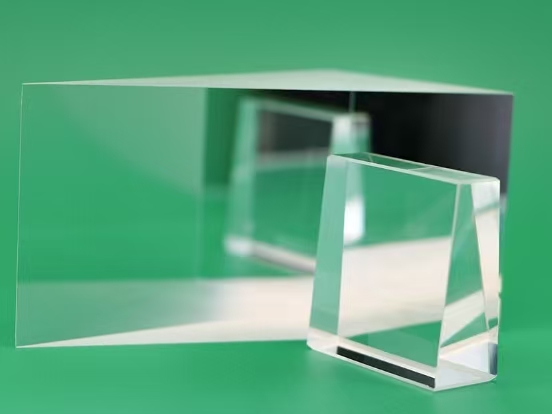
Prisms: Spectral Separation via Refraction
Performance Differences and Application Scenarios
Spectral Uniformity
Gratings: Produce relatively uniform intensity distribution across wavelength intervals, fully revealing spectral characteristics. Ideal for detailed spectral analysis.
Prisms: Exhibit poorer uniformity; intensity in some wavelength regions may be attenuated or compressed. More suitable for targeted detection of specific wavelength ranges.
Wavelength Coverage
Gratings: Adjustable surface structures enable broad wavelength coverage, supporting multi-band spectral separation widely used in wide-range spectral analysis.
Prisms: Limited by material transmittance; wavelengths outside the transparent range are strongly absorbed and cannot be efficiently separated. Better suited for fixed, narrow-band spectroscopic tasks.
Energy Loss
Gratings: Energy loss arises from inefficient diffraction and surface reflection, especially pronounced at spectral edges.
Prisms: Loss mainly stems from material absorption and surface reflection, which can be minimized via high-grade optical materials and anti-reflection coatings, preserving high output intensity. Preferred for applications demanding strong optical signals.
Dispersion Characteristics
Gratings: Display linear dispersion, where wavelength and deflection angle maintain a fixed proportional relationship, simplifying spectral calibration and data processing—advantageous for quantitative analysis.
Prisms: Exhibit nonlinear dispersion, with stronger deflection and separation for shorter wavelengths. Ideal for emphasizing separation in the short-wavelength region.
Conclusion