

Functions and Applications of Cylindrical Lenses
Apr. 16, 2026
Principle
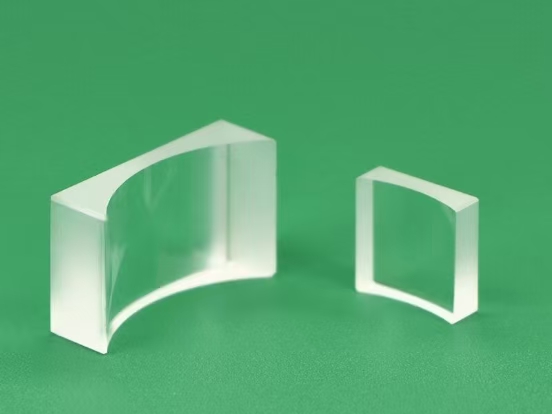
The core optical principle of a cylindrical lens is uniaxial linear focusing: it converges or diverges light only along one single axis, while producing no refractive effect along the orthogonal axis. This forms the light beam into a linear focus instead of a point focus, enabling precise one-dimensional light control.
Its unique asymmetric curved surface allows it to shape the beam only in one direction, while leaving beam properties unchanged in the perpendicular direction, thereby achieving one-dimensional beam shaping and size adjustment.
With a dual cylindrical lens combination system, the elliptical beam from a laser diode can be reshaped by expanding the short axis and collimating the long axis separately. This realizes asymmetric beam correction, efficiently converting an elliptical beam into a symmetric circular beam.
Comparison with Spherical Lenses
Cylindrical lenses focus along a single axis and form a linear focus. Spherical lenses focus symmetrically in all directions and form a point focus. Cylindrical lenses control light only in one dimension and are suitable for beam shaping and linear scanning. Spherical lenses control light uniformly in two dimensions and are commonly used for conventional imaging and magnification.
Main DifferencesFocus form:
cylindrical lenses provide linear focusing, while spherical lenses provide point focusing.
Light control dimension: cylindrical lenses offer one-dimensional control, while spherical lenses offer full-dimensional control.
Application scenarios: cylindrical lenses are used for linear precision applications, while spherical lenses are used for uniform imaging applications.
Importance in Optical and Industrial Applications
In laser line scanning, cylindrical lenses shape laser beams into narrow lines that scan across object surfaces. This technology is widely used in 3D profilometers, laser 3D scanners and other equipment, enabling high-precision defect detection and dimensional measurement.
In the field of optical information processing, cylindrical lenses perform data analysis by focusing light into lines, such as in spectrum analyzers and barcode scanners. Their one-dimensional light control ensures stable and reliable performance in applications requiring linear precision.
In medical imaging systems, cylindrical lenses are key components of imaging and diagnostic equipment. Their line-focusing characteristic improves the resolution and accuracy of optical systems. Diagnostic instruments including retinal imaging systems, slit lamps and OCT (Optical Coherence Tomography) scanners rely on cylindrical lenses for high-precision detection.