


Ball Lenses for Endoscope and Medical Imaging Systems: How They Enable Miniaturized High-Performance Optics
Sep. 18, 2026
Introduction
Modern medical imaging systems are continuously moving toward smaller, more precise, and minimally invasive designs. From flexible endoscopes used in gastrointestinal examinations to advanced micro-imaging systems for surgical guidance, optical components must deliver high image quality while fitting into extremely limited spaces.
Among various micro-optical components, ball lenses have become an important solution for compact optical systems due to their small size, high numerical aperture (NA), excellent light collection capability, and flexible coupling performance. They are widely used in applications such as endoscopes, fiber-optic imaging systems, medical sensors, and miniature diagnostic devices.
Unlike traditional multi-element lenses, ball lenses provide a simple spherical design that can achieve efficient focusing and imaging performance within very small optical assemblies. For medical equipment manufacturers, customized ball lenses offer opportunities to optimize optical performance, reduce device size, and improve imaging reliability.
What Is a Ball Lens?
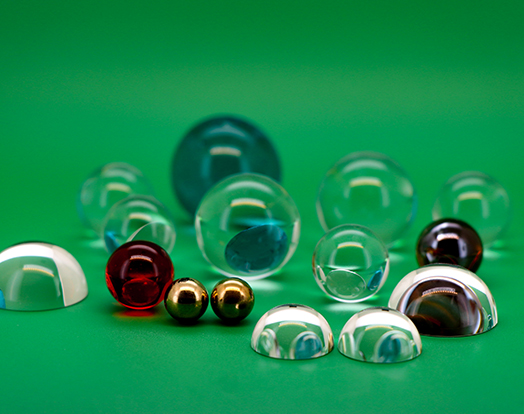
A ball lens is a spherical optical lens manufactured from transparent optical materials such as glass, sapphire, or other high-performance optical materials.
Unlike conventional lenses with different front and rear curvatures, a ball lens has:
A fully spherical shape
The same radius of curvature across the entire surface
Compact dimensions
Short effective focal length
High light collection capability
Because of its spherical geometry, a ball lens can efficiently bend and focus light, making it suitable for applications where optical space is extremely limited.
In medical imaging systems, ball lenses are typically installed at the distal tip of miniature devices to collect light from tissues or objects and transfer images to sensors or optical fibers.
Why Are Ball Lenses Used in Endoscope Systems?
1. Compact Size Enables Minimally Invasive Device Design
One of the biggest challenges in medical imaging is achieving high-quality visualization while keeping the instrument diameter as small as possible.
Traditional optical systems often require multiple lenses, spacers, and mechanical structures, increasing the size and complexity of the device.
Ball lenses solve this challenge by providing:
Extremely compact optical structure
Fewer optical elements
Easy integration into small-diameter probes
Reduced overall system size
This makes them suitable for:
Flexible endoscopes
Micro-endoscopes
Catheter-based imaging devices
Surgical imaging tools
Miniaturized optics are particularly important in modern endoscopic systems because smaller devices can improve accessibility and reduce patient discomfort.
2. High Numerical Aperture Improves Light Collection
Medical imaging often involves observing biological structures under low-light conditions. Efficient light collection directly affects image brightness and clarity.
Ball lenses provide a high numerical aperture (NA), allowing them to:
Capture more incoming light
Improve signal efficiency
Enhance image brightness
Support high-resolution imaging
This characteristic is especially valuable for:
Fluorescence imaging
Confocal microscopy
Micro-endoscopy
Fiber-optic imaging systems
Because ball lenses have short focal lengths relative to their diameter, they can focus or collect light efficiently in compact optical paths.
3. Efficient Optical Coupling With Fiber Systems
Many medical imaging devices rely on optical fibers to transmit illumination and image signals.
Ball lenses are widely used for fiber coupling because they can efficiently transfer light between:
Optical fibers and sensors
Laser sources and fibers
Imaging modules and detectors
Advantages include:
Improved coupling efficiency
Easier alignment
Reduced optical loss
Compact packaging
The spherical design also provides alignment advantages because the lens remains rotationally symmetric, simplifying assembly compared with complex lens groups.
4. Wide Field of View for Medical Observation
Endoscope systems often require a wide viewing angle to observe larger areas inside the human body.
A properly designed ball lens can provide:
Wide-angle imaging capability
Large viewing range
Compact optical structure
This is beneficial for applications such as:
Gastrointestinal endoscopy
Dental imaging
Surgical visualization
Micro-inspection systems
By customizing the ball lens diameter, refractive index, and optical design, manufacturers can balance field of view, resolution, and working distance.
5. Simplified Optical Structure Reduces System Complexity
Medical devices require reliability and consistent performance.
Compared with complicated multi-lens assemblies, ball lenses offer:
Simple mechanical integration
Fewer alignment requirements
Reduced manufacturing complexity
Improved repeatability
For medical equipment manufacturers producing large volumes of imaging devices, simplified optical structures can help improve production efficiency and reduce assembly challenges.
Key Applications of Ball Lenses in Medical Imaging
Endoscope Objective Lenses
Ball lenses can serve as objective lenses at the front end of endoscopes.
They help:
Capture images from internal tissues
Transfer light into optical systems
Maintain compact device dimensions
Applications include:
Gastrointestinal endoscopes
Arthroscopes
Bronchoscopes
Urological endoscopes
Fiber-Optic Medical Imaging
Fiber-based imaging systems require efficient light coupling between tiny optical components.
Ball lenses are used in:
Fiber-optic probes
Optical coherence tomography systems
Fluorescence imaging devices
Biomedical sensing systems
Surgical Microscopy and Micro-Imaging
Miniature optical systems used in research and surgery often require high-resolution imaging in restricted spaces.
Ball lenses can support:
Compact microscope designs
High magnification imaging
Micro-scale observation
Medical Laser Systems
Ball lenses are also used for optical coupling in medical laser equipment.
Applications include:
Laser therapy devices
Laser delivery systems
Photodynamic therapy equipment
They help focus and transfer laser energy efficiently into optical fibers or treatment areas.
Customization Options for Medical Ball Lenses
Medical optical systems usually have strict performance requirements. Therefore, customized ball lenses are often preferred over standard products.
Important customization parameters include:
Lens Material
Common materials include:
Optical glass
Sapphire
Fused silica
High-index optical materials
Material selection depends on:
Wavelength range
Mechanical requirements
Chemical resistance
Sterilization environment
Diameter and Dimension Control
Medical devices require precise mechanical integration.
Customization may include:
Ball diameter
Diameter tolerance
Surface accuracy
Edge quality
Small dimensional differences can significantly affect optical alignment in miniature imaging systems.
Optical Performance Requirements
Manufacturers may customize:
Effective focal length
Numerical aperture
Working distance
Transmission performance
Resolution requirements
These parameters determine how well the ball lens performs inside a complete imaging system.
Surface Quality and Coatings
For high-performance medical imaging, surface quality is critical.
Typical requirements include:
Low surface roughness
High polishing accuracy
Anti-reflection coating
Enhanced transmission coating
Coatings can improve optical efficiency and reduce unwanted reflections.
Ball Lens vs Traditional Micro Lenses for Medical Applications
| Feature | Ball Lens | Traditional Micro Lens |
|---|---|---|
| Structure | Single spherical element | Multiple optical elements |
| Size | Extremely compact | Usually larger |
| Light collection | High NA capability | Depends on design |
| Alignment | Relatively simple | More complex |
| Manufacturing | Simplified | More complicated |
| Application | Micro-optics, fiber coupling, endoscopy | Advanced imaging assemblies |
For applications where space is limited and efficient optical coupling is required, ball lenses provide unique advantages.
Challenges When Using Ball Lenses in Medical Imaging
Although ball lenses offer many advantages, engineers must carefully optimize their design.
Optical Aberration Control
Due to their spherical shape, ball lenses may introduce optical aberrations, including:
Spherical aberration
Field curvature
Distortion
Therefore, optical simulation and customized design are important for high-resolution imaging applications.
Precise Assembly Requirements
Even small alignment errors may affect:
Image sharpness
Light coupling efficiency
System performance
Professional manufacturing and precision assembly are necessary for medical-grade applications.
Sterilization Compatibility
Medical devices often require repeated sterilization.
Engineers must consider:
Material durability
Coating stability
Chemical resistance
Temperature resistance
How to Select a Ball Lens Manufacturer for Medical Applications?
For medical imaging projects, buyers should evaluate suppliers based on:
Optical Manufacturing Capability
A reliable supplier should provide:
Precision grinding and polishing
Strict dimensional control
Optical inspection
Custom optical design support
Material and Coating Expertise
The supplier should understand:
Medical wavelength requirements
Optical material selection
Coating performance
Environmental durability
Prototype and Mass Production Support
Medical device development often requires:
Prototype samples
Design verification
Small-batch production
High-volume manufacturing
A supplier with flexible production capability can support different development stages.
Conclusion
Ball lenses play an important role in modern endoscope and medical imaging systems by providing compact design, efficient light collection, high numerical aperture, and flexible optical integration.
As medical devices continue moving toward minimally invasive procedures and smaller imaging platforms, customized ball lenses offer manufacturers a practical solution for improving optical performance while reducing system size.
For medical equipment developers, selecting the right ball lens design, material, and manufacturing partner is essential to achieving reliable, high-quality imaging performance.

Previous: None
Next: Why Are Customizable Silicon Domes Used in Optical Systems?