


Ball Lenses for Compact Optical Modules: A Practical Guide for Optical Design
Jun. 24, 2026
Ball lenses are widely used in compact optical modules because they combine extremely small size with strong optical performance. As optical systems continue to shrink in size while increasing in complexity, these spherical components play an important role in fiber optics, laser systems, sensing devices, and miniature imaging solutions.
This article explains how ball lenses work, why they are used in compact optical assemblies, where they are applied, what materials are commonly used, and what factors engineers consider when selecting them.
What Is a Ball Lens?
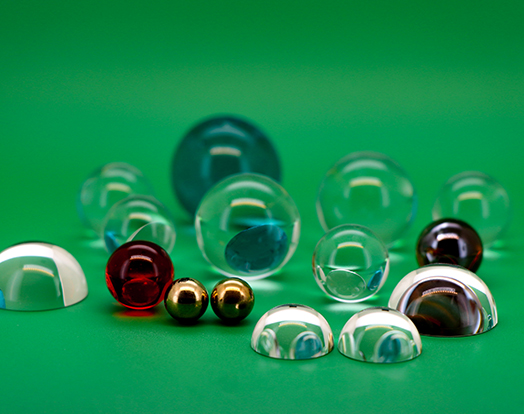
A ball lens is a perfectly spherical optical component made from transparent materials such as optical glass, fused silica, sapphire, or infrared crystals. Unlike traditional lenses that rely on curved surfaces, a ball lens uses its full spherical geometry to manipulate light.
When light enters the sphere, it is refracted at the surface and travels through the internal medium before converging or collimating depending on the optical configuration. This simple structure allows it to perform useful optical functions within extremely small spaces.
Because of its geometry, a ball lens can be integrated directly into compact optical modules without requiring complex mounting or multi-element lens assemblies.
Why Ball Lenses Are Used in Compact Optical Modules
Compact optical modules are designed to achieve high optical performance in very limited space. Ball lenses are particularly suitable for this environment due to several practical advantages.
One key advantage is their extremely small size. They can be placed close to light sources such as laser diodes or optical fibers, making them ideal for dense optical assemblies.
Another advantage is efficient light handling. In many coupling and focusing applications, ball lenses provide stable optical transmission with relatively low loss when properly aligned.
Their simple geometry also reduces system complexity. Compared to multi-element optical systems, ball lenses require fewer alignment steps during assembly, which improves manufacturability in compact devices.
In addition, they are relatively cost-efficient to produce, which supports their use in both industrial and commercial optical products.
How Ball Lenses Work in Optical Systems
The working principle of a ball lens is based on refraction inside a spherical medium. When light enters the lens, it bends at the air-glass interface and travels through the material in curved paths.
Depending on the position of the light source and the refractive index of the material, the light may converge to a focal point or emerge as a collimated beam.
A key parameter in this process is the back focal length, which determines the distance between the lens surface and the focal point. This value is critical in applications such as fiber coupling and laser alignment, where precise positioning directly affects system efficiency.
Engineers adjust lens diameter, refractive index, and spacing to achieve the desired optical behavior in compact designs.
Applications in Compact Optical Modules
Ball lenses are used in many optical systems where size constraints are important.
In fiber optic communication, they are commonly used to couple light between laser diodes and optical fibers. This helps improve transmission efficiency and reduce signal loss in high-speed communication systems.
In laser-based devices, ball lenses are used for beam focusing and collimation. They appear in barcode scanners, distance measurement tools, LiDAR systems, and industrial sensing equipment.
In imaging systems, ball lenses are used in miniature cameras, endoscopic instruments, and compact optical sensors where traditional lens assemblies would be too large.
In medical and biomedical devices, they support imaging and diagnostic systems that require precise optical control in very small spaces.
They are also widely used in optical sensing applications such as environmental monitoring, photodetectors, and industrial inspection systems.
Materials Used for Ball Lenses
The choice of material has a direct impact on optical performance and environmental suitability.
Optical glass such as BK7 is commonly used due to its good transmission in the visible range and relatively low cost. It is suitable for general optical applications.
Fused silica offers higher thermal stability and better resistance to laser damage, making it suitable for high-power or precision optical systems.
Sapphire is known for its hardness and durability. It performs well in harsh environments where mechanical strength and scratch resistance are required.
Infrared materials such as germanium or zinc selenide are used in thermal imaging and infrared sensing systems where visible glass cannot operate effectively.
Key Considerations When Selecting Ball Lenses
Several factors must be evaluated when integrating ball lenses into compact optical modules.
Diameter is one of the most important parameters. Smaller diameters enable more compact designs but require higher precision in alignment.
Refractive index affects how strongly the light is bent inside the lens, influencing focal length and beam behavior.
Surface quality plays a significant role in optical clarity. High-quality polishing reduces scattering and improves transmission efficiency.
Transmission range must match the operating wavelength of the system, whether visible, infrared, or ultraviolet.
Back focal length is especially important in fiber coupling and laser applications because it determines the optimal distance between the lens and the light source.
Comparison with Traditional Optical Lenses
Ball lenses differ significantly from conventional optical lens systems.
Traditional lenses are often designed for imaging quality and optical correction, allowing more flexibility in controlling aberrations. However, they usually require more space and complex alignment.
Ball lenses are designed for simplicity and compact integration. They are particularly effective in light coupling and beam control within small optical modules, where space efficiency is more important than advanced imaging performance.
For this reason, ball lenses are typically used as functional components in compact systems rather than as general-purpose imaging lenses.
Design Considerations in Optical Integration
When designing compact optical modules with ball lenses, precise alignment is essential.
The spacing between the light source and the lens directly influences optical efficiency. Even small deviations can affect coupling performance.
Anti-reflection coatings are often applied to reduce surface reflections and improve transmission efficiency, especially in high-performance systems.
Thermal stability must also be considered, particularly in environments with temperature fluctuations. Material compatibility helps maintain consistent optical behavior.
Mechanical stability is equally important, as vibration or movement can impact alignment and degrade performance in compact assemblies.
Future Development Trends
As optical technology continues to evolve toward miniaturization and higher integration, ball lenses are expected to play an even more important role.
They are increasingly used in emerging technologies such as augmented reality optical engines, micro-LiDAR systems, photonic integration platforms, and high-speed optical interconnects.
Advances in precision manufacturing and coating technologies are improving their optical performance and expanding their use in next-generation compact systems.
Conclusion
Ball lenses are essential components in compact optical modules due to their small size, simple structure, and strong optical performance. They are widely used in fiber optics, laser systems, imaging devices, and sensing technologies.
As optical systems continue to become smaller and more integrated, ball lenses will remain an important solution for achieving efficient light control in limited spaces.