


How Do Ball Lenses Improve Light Coupling Efficiency?
Jun. 24, 2026
Light coupling efficiency is a critical performance factor in optical systems, especially in fiber optics, laser modules, and compact photonic devices. Even small losses during light transfer can significantly impact signal strength, system stability, and overall performance. Ball lenses are widely used to improve this efficiency because they provide highly controlled light focusing and beam shaping in extremely small spaces.
This article explains how ball lenses enhance light coupling efficiency, the physics behind their performance, and where they are most effectively applied.
What Light Coupling Means in Optical Systems
Light coupling refers to the process of transferring optical power from one component to another, such as from a laser diode into an optical fiber, or between two fibers.
The main challenge in coupling is matching the properties of the light source with the receiving medium. These properties include beam diameter, divergence angle, numerical aperture, and alignment accuracy.
Without proper optical matching, a significant portion of light is lost due to divergence, reflection, or misalignment.
Why Ball Lenses Are Effective for Light Coupling
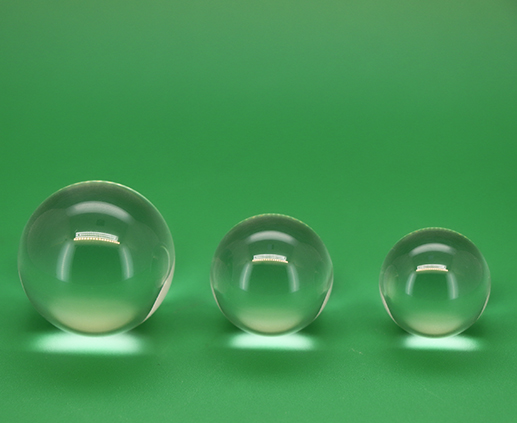
Ball lenses improve coupling efficiency primarily by acting as a miniature, highly symmetric focusing element. Their spherical geometry allows them to manipulate light in a predictable and compact way.
One of the most important advantages is their ability to collect divergent light from a source and refocus it into a smaller, more controlled beam. This is especially useful for laser diodes, which naturally emit highly divergent beams.
By placing a ball lens close to the light source, the emitted light can be efficiently captured and redirected toward an optical fiber or another optical component with much better spatial matching.
Beam Transformation and Numerical Aperture Matching
A key reason ball lenses improve coupling efficiency is their ability to match numerical apertures between optical components.
Laser diodes often emit light with a wide angular spread, while optical fibers can only accept light within a limited acceptance angle. This mismatch leads to losses if not corrected.
A ball lens reduces this mismatch by reshaping the beam profile. It collects high-divergence light and converts it into a beam with reduced divergence that fits within the acceptance angle of the receiving fiber.
This optical transformation significantly increases the amount of usable transmitted light.
Role of Focal Position and Back Focal Length
The performance of a ball lens in coupling applications depends heavily on the correct positioning of the light source relative to the lens.
The back focal length determines where the light converges after passing through the lens. If the laser diode or fiber end is placed at an optimal distance from this focal point, maximum coupling efficiency can be achieved.
Even slight misalignment in this distance can reduce efficiency, which is why precise mechanical design is important in compact optical modules.
Reduction of Optical Losses
Ball lenses help reduce multiple types of optical losses at once.
They reduce geometric losses by focusing more light into the active area of the fiber or detector. They also minimize divergence losses by controlling beam spread after emission.
When used with anti-reflection coatings, surface reflection losses at the air-to-glass interface can also be significantly reduced, further improving transmission efficiency.
In high-quality systems, these combined improvements can lead to noticeably higher optical throughput compared to direct coupling methods.
Alignment Tolerance Advantages
One of the practical benefits of ball lenses is improved alignment tolerance.
Direct coupling between a laser diode and a fiber requires extremely precise positioning. Even microscopic misalignments can cause large efficiency drops.
A ball lens acts as an intermediary optical element that relaxes alignment sensitivity. It allows a slightly wider positional tolerance while still maintaining efficient coupling. This simplifies manufacturing and reduces assembly cost in compact optical modules.
Material Influence on Coupling Performance
The material of the ball lens also plays a role in coupling efficiency.
Optical glass is commonly used for standard visible-light systems due to its good transmission and cost efficiency.
Fused silica provides better performance in high-power or high-precision systems because it reduces thermal distortion and handles higher optical intensity.
Infrared materials are used when coupling occurs in non-visible wavelength ranges, such as thermal imaging or IR communication systems.
The correct material choice ensures minimal absorption and maximum transmission efficiency.
Typical Applications Where Ball Lenses Enhance Coupling
Ball lenses are widely used in systems where efficient light transfer is essential.
In fiber optic communication modules, they improve coupling between laser diodes and single-mode or multimode fibers, helping maintain signal strength over long distances.
In laser scanning systems, they ensure stable beam delivery for barcode readers, industrial scanners, and measurement tools.
In medical optical devices, they help transfer light efficiently into miniature probes used in endoscopy and diagnostic imaging.
They are also used in photodetectors and sensor systems where maximizing collected light improves measurement accuracy.
Design Considerations for Maximum Efficiency
To achieve optimal coupling performance, several design factors must be carefully controlled.
The spacing between the light source and the ball lens must be precisely defined. This distance directly affects focal alignment and beam quality.
The optical axis alignment between components must be maintained within tight tolerances to avoid asymmetric beam loss.
Surface coatings are often applied to reduce reflection losses at entry and exit surfaces.
Thermal and mechanical stability must also be considered to ensure consistent performance under varying environmental conditions.
Conclusion
Ball lenses improve light coupling efficiency by collecting divergent light, reshaping beam profiles, and better matching optical interfaces such as laser diodes and fibers. Their compact structure, optical symmetry, and ability to reduce alignment sensitivity make them a key component in modern optical modules.
In applications where space is limited but high optical performance is required, ball lenses provide a practical and highly effective solution for maximizing light transmissio.