


Coating technology: the key to improving the performance of beam splitters
Nov. 28, 2025
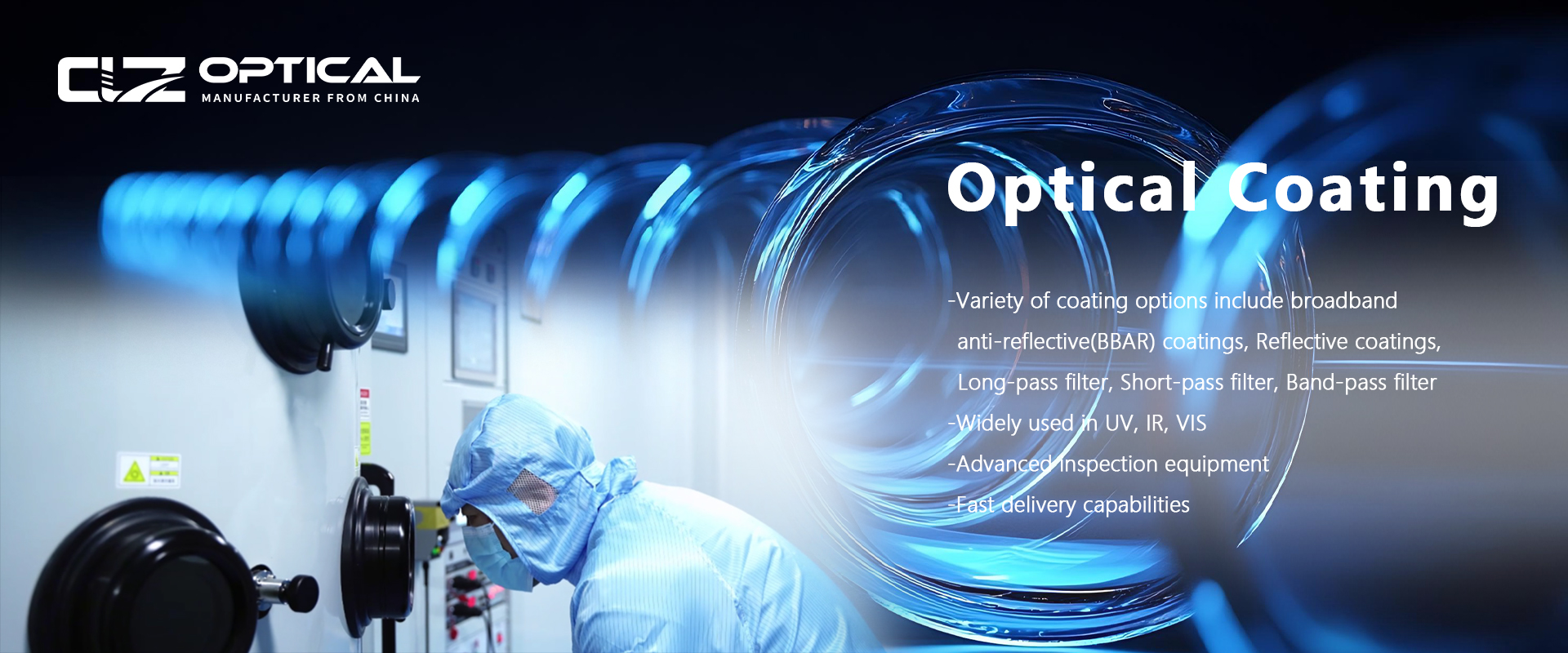
According to Fresnel's formula, approximately 4% of light is reflected at each interface on an uncoated glass surface. For a complex beam splitter composed of multiple prisms bonded together, multiple reflections lead to significant energy loss, stray light, and ghosting, resulting in a weak final output signal with extremely poor signal-to-noise ratio. The core mission of a beam splitter is “precise light splitting.” Therefore, coating the beam splitter is designed to re-route the light path, precisely controlling its reflection and transmission behavior at each interface to achieve high-efficiency, high-precision light splitting.
Depending on design objectives and principles, coatings applied to beam splitters are primarily categorized into the following types, each with unique characteristics that work in concert.
Coating Classification
1. Antireflective Coating
Antireflective coatings, also known as anti-reflective coating, are the most widely used optical thin coating. Their mission is simple yet crucial: to minimize surface reflection and maximize transmittance.
Working Principle: They utilize the principle of light interference. When the optical thickness of the coating is one-quarter of the incident light wavelength, and the refractive index of the coating is between that of air and the substrate, the two beams of light reflected from the front and back surfaces of the coating will undergo destructive interference, thus canceling each other out. This drastically reduces the reflected light energy and significantly enhances the transmitted light energy.
Selection and Application: For single wavelengths, a single-layer antireflective coating can be used. However, for applications with a wide spectral range (such as visible light imaging systems), multi-layer broadband antireflective coatings are required. By combining layers of different thicknesses and materials, extremely low reflectivity can be achieved across the entire wavelength range. The reflectivity of a single interface in modern high-end beam splitters can be reduced to below 0.1% with the help of antireflective coatings, greatly improving the light transmission efficiency and contrast of the optical system.
2. Beam Splitter coating
The beam splitter coating is the "heart" of a beam splitter prism, directly determining its core beam splitting characteristics. Its core function is to split a beam of incident light into two or more beams with different spectral compositions or intensities in a predetermined and precise manner. It is the decisive component for the beam splitter prism to achieve its "optical path conductor" function. When light is incident on the thin film interface, reflection and transmission occur at each interface. By designing the thickness, refractive index, and number of layers of multilayer thin films, the phase relationship between the light waves reflected from each layer interface can be precisely controlled. By constructing constructive interference to enhance light in a specific direction (reflected or transmitted), or by using destructive interference to suppress it, the desired beam splitting effect is achieved macroscopically.
Beam Splitter Coating are mainly divided into two categories, which differ significantly in terms of materials, performance, and applicable scenarios.
- Metallic Beam Splitter
These beam splitters are made from metals such as aluminum, silver, and chromium.
Working Principle: They primarily utilize the natural property of metals to partially reflect and partially transmit light. When light energy passes through the metal film, part is reflected, part is transmitted, and part is absorbed.
Spectral Characteristics: They typically exhibit neutral or near-neutral reflectivity. This means that at the designed incident angle, the reflectivity and transmittance across the entire operating wavelength band (such as visible light) remain relatively constant. For example, a 50/50 metallic beam splitter will have roughly the same reflectivity and transmittance for red, green, and blue light.
Advantages: Relatively simple to manufacture and low cost. Insensitive to the angle and polarization state of incident light, with stable performance.
Disadvantages: High absorption loss. This is the most significant problem with metallic films. Typically, 15% to 20% of the light energy is absorbed by the film and converted into heat. This not only leads to low system optical efficiency but may also cause lens deformation and adhesive layer cracking due to thermal effects, affecting system stability and lifespan.
Application scenarios: Primarily used in scenarios where light energy efficiency requirements are not high, but wide-spectrum uniform spectral dispersion is required and cost is sensitive, such as some simple optical demonstration devices and ordinary optical instruments with low brightness requirements.
- Dielectric Beam Splitter
These beam splitters are made by alternating layers of two or more transparent dielectric materials (such as titanium dioxide, tantalum pentoxide, silicon dioxide, aluminum oxide, etc.) to achieve beam splitting through interference.
Working Principle: By alternately layering high-refractive-index and low-refractive-index dielectric materials and precisely controlling the optical thickness of each layer (typically 1/4 wavelength), an interference filter is constructed. Through complex film system design, the "fate" of different wavelengths of light can be specified, much like programming.
Spectral Characteristics: Highly customizable. This is the most powerful advantage of dielectric coatings. They can be designed into several specific types:
1) Neutral Beam Splitter: Similar to metallic coating, it achieves a fixed splitting ratio (e.g., 50/50, 70/30) across the entire wavelength range, but with extremely low absorption loss (typically <1%), resulting in much higher efficiency than metallic films.
2) Dichroic Beam Splitter: This is the most classic application of dielectric beam splitters. It selectively reflects (or transmits) light within a specific wavelength range while transmitting (or reflecting) light of other wavelengths.
3) Long-pass coating: Reflects short wavelengths and transmits long wavelengths. (e.g., reflects blue light and transmits red and green light)
4) Short-pass coating: Reflects long wavelengths and transmits short wavelengths. (e.g., reflects red light and transmits blue and green light)
5) Bandpass coating: Reflects a specific wavelength band and transmits light outside that band.
Advantages: Extremely low absorption loss, high light energy utilization. Excellent spectral splitting performance, enabling complex, steep cutoff edges. High durability and laser damage threshold, suitable for high-power laser systems.
Disadvantages: Very complex design and fabrication, high cost. Performance is very sensitive to the incident angle and the polarization state of the light. When light is incident at an angle, the splitting characteristics (especially the cutoff wavelength) shift significantly (“blue shift”). Simultaneously, a polarization effect occurs, resulting in different splitting ratios for S-polarized and P-polarized light.
Applications: Almost all high-performance optical systems.
Projectors: The core components, the dichroic mirror and the X-Cube prism, utilize dichroic beam-splitting films for efficiently separating and combining the three primary colors: red, green, and blue.
Fluorescence microscopes: Use dichroic mirrors to precisely separate excitation and emission light.
Spectrometers: Serving as the core beam-splitting element.
Laser systems: Used for beam combining and splitting, handling high power.
Comparison and Choice Between Metallic and Dielectric coatings
Choosing between metallic and dielectric films involves a trade-off between performance and requirements.
Metallic coating excel in simple manufacturing processes, lower cost, and good spectral neutrality, making them suitable for applications where high light energy efficiency is not required, but a wide-spectral uniform spectral distribution is needed.
Dielectric coating excel in superior performance, low loss, high durability, and spectral designability, making them the ideal choice for modern precision instruments, high-end projection, and spectral analysis. Although their design and fabrication are more complex and costly, the performance improvements they provide are revolutionary.